
Polio Vaccination in Pakistan: Punjab Law, Police Enforcement, FIRs and the Facts:
The Facts, the Law, the Vaccine, and Why Government Teams Come to Your Door
By
Gull Hassan Khan, Advocate High Court
CEO, Pak-Lawyer Associates
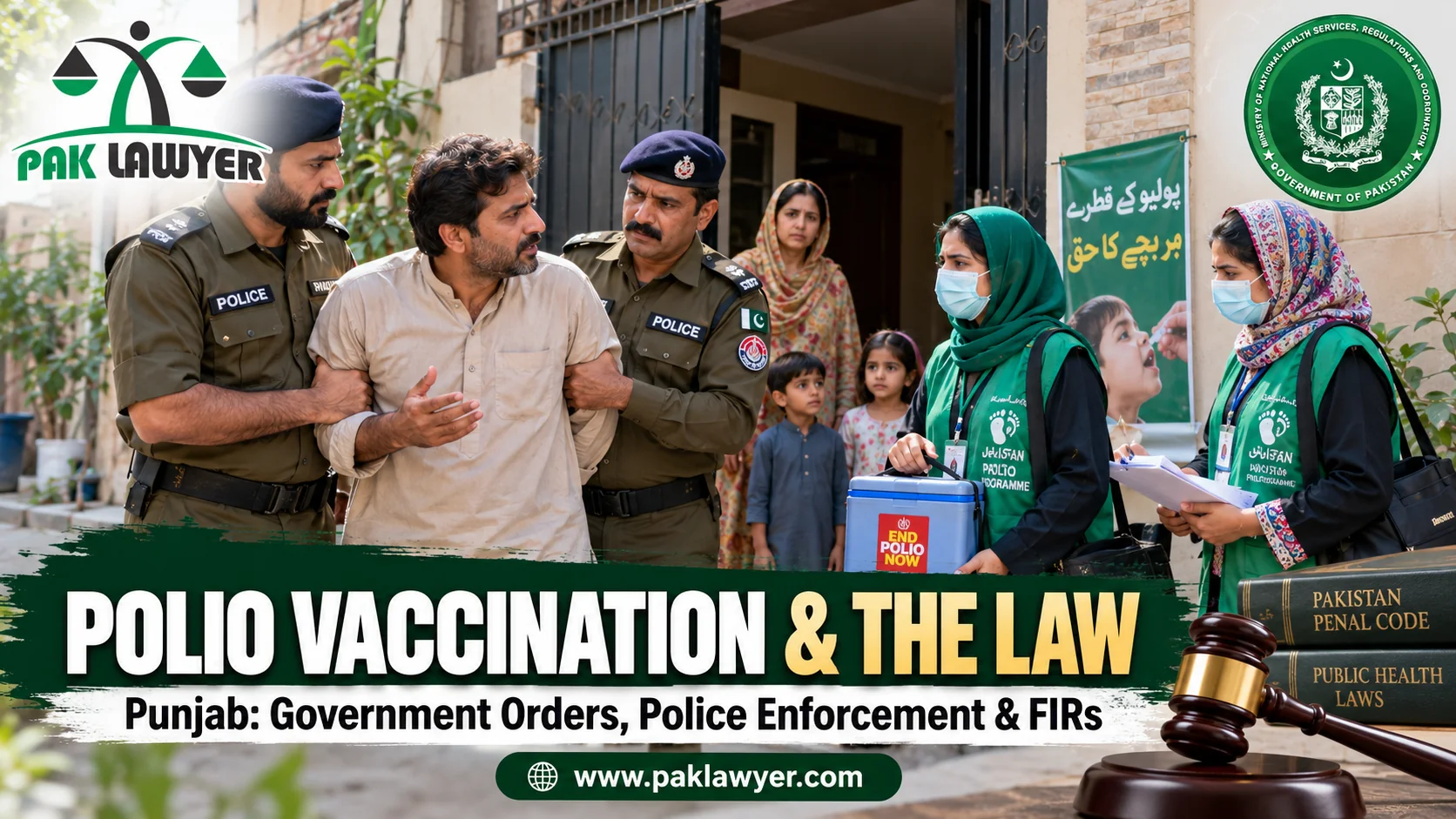
In Pakistan, few public-health programmes are as visible as the anti-polio campaign.
Every few weeks, teams of vaccinators appear at our streets, houses, schools, bus stations and other public places. They carry small vaccine vials, mark children’s fingers and record vaccination data. In Punjab, the government has developed an exceptionally large field operation to ensure that children below five years of age are not missed.
Personally, I have observed something remarkable: I have rarely seen a government department operating with the same level of field activity, household coverage and repeated follow-up as the polio programme.
But this visibility has also generated questions.
Why does the government repeatedly vaccinate children who have already received polio drops?
Why does the team come directly to the home?
Where does the vaccine come from?
Who pays for it?
Why are international organisations involved?
Can parents legally refuse?
Can police arrest parents?
And, perhaps most importantly, is there any truth behind the allegations that polio vaccination in Pakistan is part of a foreign conspiracy against Pakistanis?
These questions deserve facts—not slogans.
- Why is Pakistan still vaccinating against polio?
Polio is not simply an ordinary childhood illness.
Poliomyelitis is a highly infectious viral disease. It can invade the nervous system and cause permanent paralysis. There is no cure for paralytic polio; prevention through vaccination is the principal protection.
Pakistan remains one of the very few countries where wild poliovirus continues to circulate. Afghanistan is the other major endemic country.
Pakistan’s progress, however, has been extraordinary.
The Pakistan Polio Eradication Programme reports that the country has reduced polio cases by approximately 99.8% compared with the estimated 20,000 cases annually in the early 1990s. Pakistan recorded 31 cases in 2025, while the official programme reported five cases during 2026 by late September.
That decline is important evidence that vaccination has had a major effect.
But eradication is different from reduction.
As long as wild poliovirus continues circulating in Pakistan or neighbouring Afghanistan, an unvaccinated child remains vulnerable.
- Why do children receive polio drops repeatedly?
This is one of the most common questions asked by parents.
A parent may reasonably ask:
“My child already received the polio vaccine. Why are you giving it again?”
The answer is that Pakistan uses both routine immunisation and supplementary immunisation activities.
Under the routine schedule, oral polio vaccine is administered at birth and at specified infant ages, while injectable inactivated polio vaccine is also included in the routine programme.
Supplementary campaigns are different. They are designed to increase population immunity rapidly and interrupt transmission.
The Federal Directorate of Immunization explains that every child below five years should be reached during supplementary immunisation activities because multiple doses are required to develop adequate immunity in a high-endemicity environment.
Therefore:
Repeated drops do not mean that the previous dose was necessarily ineffective.
They are part of a strategy designed to close immunity gaps across the population.
The programme itself explains that when poliovirus is detected in an area, additional campaigns may be conducted to prevent transmission.
- Why does the government come to our homes?
The answer is simple: the virus does not wait for a child to visit a hospital.
If vaccination were offered only at government hospitals or basic health units, many children would never be reached.
Pakistan has enormous population movement, densely populated urban areas, informal settlements, remote villages and communities where routine healthcare access is inconsistent.
The government’s strategy is therefore based on door-to-door coverage.
In the April 2026 nationwide campaign, more than 400,000 frontline workers were mobilised across Pakistan, and more than 44.8 million children were reached. The programme reported coverage of approximately 99% of households.
In Punjab alone, enormous numbers of workers are deployed.
During a September 2026 campaign, Punjab targeted more than 10 million children under five in 13 districts, with more than 77,000 polio workers and nearly 40,000 mobile, fixed and transit teams involved. Lahore was among the districts covered.
This explains something that many people experience personally:
The polio team may appear at your door even when you did not ask for the service.
The programme is deliberately designed that way.
- Why does Punjab appear to be particularly aggressive about polio vaccination?
Punjab is Pakistan’s most populous province and contains enormous urban and mobile populations.
Lahore, Rawalpindi, Faisalabad and other major population centres are connected to national transport routes and receive large numbers of people from other parts of Pakistan.
This matters because poliovirus can travel with infected people who may show no obvious symptoms.
UNICEF has specifically identified Lahore and Rawalpindi among major districts containing highly mobile populations, creating additional challenges for polio eradication.
Therefore, the government’s objective is not simply:
“Vaccinate children who come to the hospital.”
It is:
“Find every eligible child, wherever that child lives.”
That is why the teams knock on doors.
4.1. : Is Polio Vaccination Merely Voluntary in Punjab?
Punjab’s anti-polio programme is not simply a voluntary social campaign. It is implemented through the provincial Health Department, district administration, Deputy Commissioners, Assistant Commissioners, police and other state institutions. During vaccination campaigns, the administration issues directions and deploys teams to ensure that children under five are reached and vaccinated. Police personnel are also regularly deployed to provide security to vaccination teams and, where necessary, to assist the administration in enforcing lawful government directions.
Where a family refuses vaccination or obstructs an officially authorised vaccination team, the matter may be reported to the district administration and police. Depending upon the circumstances, the authorities may invoke provisions of the Pakistan Penal Code, including Section 188 PPC, which deals with disobedience to an order duly promulgated by a public servant. Other provisions may also become relevant where the conduct involves obstruction, intimidation, threats, assault or conduct alleged to endanger public health—for example, Sections 186, 269, 270 and 506 PPC, depending upon the facts and the legal basis relied upon by the authorities.
There is documented precedent in Punjab. In 2019, Lahore district administration registered FIRs against several persons in connection with alleged refusal to allow polio teams to vaccinate children. One such FIR invoked Sections 186, 188, 269, 270 and 506 PPC. The authorities stated that the refusal was accompanied by alleged threats or misbehaviour towards the vaccination team.
There have also been more recent incidents. In February 2026, Lahore police registered cases after parents allegedly refused polio vaccination and subsequently attacked or harassed polio workers and police personnel. In April 2026, Rawalpindi police registered an FIR against four persons after a vaccination team reported resistance, threats and abusive behaviour during a campaign.
Accordingly, it would be incorrect to say that the government has no mechanism to enforce its polio programme. The provincial administration can use its lawful powers, and the police can assist in the enforcement of valid government orders and can register an FIR where the facts disclose a cognisable offence.
At the same time, an important legal distinction must be maintained. Registration of an FIR does not mean that every mere expression of parental concern or every question about vaccination automatically constitutes a criminal offence. The precise legal position depends upon the applicable government order, notification, statutory authority and the conduct of the individual concerned. Where refusal is accompanied by obstruction of public servants, threats, assault, intimidation or disobedience of a legally enforceable order, the possibility of criminal proceedings becomes considerably stronger.
In practical terms, therefore, a parent should not assume that saying “I do not want my child vaccinated” gives an unrestricted legal right to obstruct an authorised government vaccination campaign. At the same time, the administration must also act within the authority granted to it by law, and any coercive action should have a clear legal basis.
This distinction is particularly important because Pakistan’s courts and legal system recognise that public-health measures may involve restrictions on individual conduct where authorised by law, but administrative power cannot simply replace statutory authority.
The record also demonstrates that enforcement methods have varied over time and from province to province. For example, in 2019 the National Polio Programme expressly stated that it would not register police cases merely against parents refusing vaccination in certain districts, while still maintaining that violence or misbehaviour against vaccination teams would attract strict action.
Thus, the correct legal conclusion is not that “every parent who refuses polio drops must be arrested.” Rather, the more accurate position is:
Punjab’s polio campaign is a government public-health programme backed by the provincial administration. Police may assist in enforcing lawful orders and protecting vaccination teams, and FIRs can and have been registered where refusal is accompanied by disobedience of an applicable order, obstruction of public servants, threats, assault or other conduct attracting provisions of the Pakistan Penal Code.
- Where does Pakistan’s polio vaccine come from?
This is another area where rumours have created confusion.
The vaccine is not manufactured secretly by some unknown organisation and then distributed anonymously in Pakistan.
Pakistan procures polio vaccines through an international procurement system involving organisations such as UNICEF, with vaccines supplied by qualified manufacturers.
The Pakistan Polio Programme states that its polio vaccine comes from Indonesia. Indonesia’s Ministry of Health reported in 2025 that Bio Farma had become Pakistan’s largest polio vaccine supplier through UNICEF and that Pakistan had been seeking greater cooperation with Indonesia because of its own limited vaccine-production capacity.
UNICEF also publishes procurement and vaccine-price information as part of its transparency system.
So the basic chain is not mysterious:
Manufacturer → UNICEF/procurement system → Pakistan’s national polio programme → provincial and field vaccination operations.
- How much does the vaccine cost?
There are two different questions here.
What does the vaccine itself cost?
UNICEF publishes the prices it pays for oral polio vaccines under its supply arrangements. The price varies according to presentation, supplier, agreement and procurement conditions.
Pakistan also receives substantial financial support from international partners for vaccine procurement.
For example, in December 2024, Japan announced a US$3.1 million grant to support procurement of more than 20.22 million doses of oral polio vaccine for Pakistan’s 2025 campaigns.
In January 2024, Japan announced another US$3.62 million grant for more than 21 million doses.
Does the Pakistani parent pay for the drops?
No.
Government immunisation services are provided free of charge.
The Federal Directorate of Immunization expressly states that vaccines provided through government health facilities are free of cost.
Therefore, when a polio worker comes to your house, the parent is not being asked to purchase the vaccine.
- Is the vaccine safe?
This question deserves a serious answer—not simply “trust the government.”
The oral polio vaccine has been used internationally for decades and is one of the principal tools that brought global polio cases down dramatically.
UNICEF reports that the number of children affected by polio globally has fallen by about 99% since 1988.
The Pakistan programme states that vaccines undergo quality controls and that the vaccine used in Pakistan has been tested through the country’s regulatory laboratory system.
The programme also explains the importance of the vaccine’s cold chain and vaccine-vial monitor. These controls help ensure that vaccine is stored and administered under appropriate conditions.
No medical intervention should be described as absolutely risk-free. Parents are entitled to ask about contraindications, adverse reactions and the particular medical circumstances of their child.
But the available evidence does not support the proposition that polio vaccination in Pakistan is generally designed to harm Pakistani children.
- What about the allegation that polio vaccine causes infertility?
This is one of the most persistent rumours.
There is no credible evidence establishing that the oral polio vaccine used in Pakistan causes infertility.
Recent research examining vaccine refusal in high-risk Pakistani communities found that infertility rumours were among the concerns expressed by refusing families. The study also identified misinformation circulating through social media and WhatsApp as an important factor contributing to vaccine hesitancy.
The important distinction is:
A rumour can be widespread without becoming evidence.
If somebody claims that a particular vaccine causes infertility, the appropriate question is:
Where is the controlled scientific evidence demonstrating that causal relationship?
So far, the evidence used by international public-health authorities does not establish such a connection.
- Is there pork in the polio vaccine?
This question is particularly important in a Muslim-majority country.
The World Health Organization’s Eastern Mediterranean Regional Office has specifically addressed the issue.
WHO explains the production process and states that while a porcine-derived enzyme called trypsin can be used during preparation of certain cell cultures, it is removed and washed away before the vaccine virus is introduced, and the final oral polio vaccine does not contain porcine-origin material.
The Pakistan Polio Programme likewise states that the vaccine used in Pakistan is safe and halal.
Therefore, the allegation that the final vaccine contains pork as an ingredient is not supported by the WHO’s description of the manufacturing process.
- What about the “foreign conspiracy” theory?
This is where history becomes important.
Polio vaccination in Pakistan and Pakistan’s polio programme has suffered enormously from distrust.
One major reason is the infamous episode involving a doctor who was associated with a CIA operation using a vaccination programme as part of efforts to obtain information concerning Osama bin Laden.
That event was real and it damaged public confidence.
WHO research examining vaccine refusal in Pakistan has specifically identified the resulting suspicion of health workers and the belief that vaccination workers could be agents of foreign intelligence agencies as a factor contributing to vaccine refusal.
That historical fact should not be denied.
But there is an important logical distinction:
The misuse of a vaccination-related operation by an intelligence agency does not establish that the polio vaccine itself is a biological weapon or that today’s Pakistani vaccination programme is a conspiracy to harm Pakistani children.
Those are two different propositions.
The first has a documented historical basis.
The second requires evidence—and the evidence presently available does not establish it.
- Why are international organisations involved?
Some people ask:
“If this is Pakistan’s health programme, why are WHO, UNICEF, Rotary, Gates Foundation, Japan, Canada and other international organisations involved?”
Because polio eradication is an international public-health objective.
A virus does not recognise national borders.
Pakistan’s polio programme therefore operates with substantial international cooperation, technical assistance, financing and vaccine procurement support.
That does not mean that an international organisation owns the Pakistani child or controls the Pakistani parent.
It means that Pakistan is participating in an international eradication programme.
For example, UNICEF has supported Pakistan’s vaccination programme, while Japan has provided grants for vaccine procurement and other international partners support operational activities.
- Why are police sometimes seen with polio workers?
This is another issue that deserves careful treatment.
Polio workers have historically faced serious security threats.
Some vaccination workers and police personnel assigned to protect them have been attacked and killed.
Consequently, police protection is sometimes provided during vaccination campaigns.
But police presence can create a perception of coercion.
A polio worker accompanied by armed security personnel standing outside a house can understandably make a family feel that the vaccination programme is not merely a health service.
A publication on polio communications has specifically warned that police/security accompaniment can make communities perceive vaccination as coercive rather than protective.
That concern should be taken seriously.
- Can parents be arrested simply for refusing polio drops?
Here we need to correct a widespread misconception.
There have been instances in Pakistan where parents were arrested or detained after refusing vaccination.
For example, in Khyber Pakhtunkhwa, hundreds of parents were arrested during earlier campaigns. But contemporary reporting also noted that there was no general law at that time making childhood immunisation universally mandatory and that the arrests were made under administrative/public-order mechanisms.
More recently, Lahore police registered cases against parents after an incident in which the parents allegedly not only refused vaccination but also attacked polio workers and police officers. That is a very different legal situation from merely saying “I do not consent.”
The position in 2026 is changing.
The National Assembly approved the Polio Eradication and Rehabilitation Bill, 2026, but its application is specifically to the Islamabad Capital Territory, because health is a devolved subject. The legislation expressly makes polio immunisation mandatory in ICT and provides penalties for wilful refusal or obstruction, subject to medical contraindication.
This should not automatically be described as a nationwide Punjab law.
Indeed, the National Assembly’s own parliamentary material shows that legislative action on mandatory polio vaccination has been an ongoing policy issue.
Therefore, the legally careful statement is:
Punjab has an aggressive government-led polio vaccination in Pakistan programme and uses administrative machinery to ensure children are reached. But one should not claim, without identifying a specific applicable Punjab statute, notification or order, that every parent who merely refuses polio drops commits an offence punishable by arrest.
If refusal is accompanied by assault, threats, obstruction or other unlawful conduct, ordinary criminal law may become relevant.
- What legal framework allows the government to conduct vaccination campaigns?
Punjab’s Health and Population Department administers several public-health laws, including the Punjab Vaccination Ordinance, 1958 and the Epidemic Diseases Act, 1958.
The Epidemic Diseases Act gives provincial authorities broad powers to prescribe temporary measures when a province or part of it is threatened by a dangerous epidemic disease. Disobedience of a regulation or order made under the Act can attract consequences under section 188 of the Pakistan Penal Code.
There is also a historical Vaccination Act, 1880, although the later Punjab Vaccination Ordinance, 1958 repealed the earlier vaccination enactments applicable in its field.
Thus, the legal position should be examined through the applicable provincial legislation, notifications, public-health orders and the precise conduct of the individual involved, rather than through the simplistic statement:
“The police can arrest anyone who says no to polio.”
That statement is too broad.
- Why does the government not simply respect a parent’s refusal?
This is the central ethical and legal question.
Normally, medical treatment is closely connected with individual autonomy and consent.
But childhood vaccination creates a second consideration:
The child is a separate rights-bearing human being.
The state has an interest in protecting children from preventable disease and protecting the wider population from infectious disease transmission.
Polio presents an unusually strong public-health case because one infected person can contribute to transmission beyond his or her own household.
That is why governments around the world sometimes impose vaccination requirements in specific circumstances.
However, public-health necessity does not mean that every method of enforcement is automatically lawful.
The state still needs:
- lawful authority.
- procedural safeguards;
- appropriate medical exemptions;
- respect for fundamental rights;
- accountability of vaccination teams;
- proper vaccine storage and administration;
- mechanisms for complaints and adverse-event reporting.
- Is the government’s door-to-door strategy actually working?
There is considerable evidence that the strategy has achieved enormous reductions in polio.
The 2026 campaigns illustrate the scale.
In May 2026, approximately 163,000 frontline workers vaccinated more than 18.61 million children in 79 districts. Punjab alone accounted for more than 6.06 million vaccinated children in that campaign.
In the April 2026 nationwide campaign, more than 44.8 million children were reached.
And the country’s polio burden has fallen dramatically compared with the 1990s.
That does not prove that every administrative decision of every campaign is perfect.
It does, however, provide strong evidence that mass immunisation has played a major role in reducing transmission.
- What about the workers themselves?
Here I would make a personal observation.
Having watched government departments in Pakistan for years, one cannot ignore the unusual field presence of the polio programme.
These workers enter neighbourhoods, walk through streets, knock on doors, identify children, administer drops, mark fingers, maintain records and repeatedly return to households where children were missed.
The scale is extraordinary.
UNICEF reported in 2025 that Pakistan’s polio programme involved more than 400,000 frontline workers, including approximately 225,000 female vaccinators.
Whatever one’s opinion about government administration generally, these frontline workers deserve basic respect and protection.
Disagreeing with a policy does not justify attacking a health worker.
- But should citizens be allowed to ask questions?
Absolutely. A vaccination programme becomes stronger—not weaker—when citizens ask questions.
A responsible parent may ask:
- Which vaccine is being administered?
- Who manufactured it?
- What is its batch number?
- What is its expiry date?
- Has the cold chain been maintained?
- Is my child medically fit to receive it?
- Why does my child need another dose?
- What should I do if an adverse reaction occurs?
- Where can I verify the vaccine?
- Who is responsible for the vaccination team?
- What is the procedure for making a complaint?
These are legitimate questions.
Trust should be supported by transparency, not demanded through fear.
- The real problem with conspiracy theories
There is a difference between healthy scepticism and unsupported conspiracy theories.
Healthy scepticism says:
“Show me the evidence.”
That is completely legitimate.
A conspiracy theory says:
“The absence of evidence proves that the conspiracy is being hidden.”
That becomes impossible to test.
For Pakistan’s polio programme, there are publicly available facts about:
- the vaccine;
- manufacturers;
- procurement;
- international funding;
- vaccination numbers;
- surveillance;
- environmental sampling;
- polio cases;
- vaccine safety;
- campaign procedures;
- frontline workers.
Those facts can and should be scrutinised.
But allegations that millions of doses are secretly intended to sterilise Pakistani children require credible scientific evidence. The available evidence does not establish that proposition.
- One important criticism: coercion can undermine trust
There is another side of the story that should not be ignored.
If the state treats every hesitant parent as an enemy, the programme may become less trusted.
Research in Pakistan has identified campaign fatigue, misinformation, concerns about side effects, distrust of authorities, weak communication and dissatisfaction with repeated campaigns as factors contributing to vaccine refusal.
Therefore, the most effective approach may not simply be:
“Vaccinate or face the police.”
It should also be:
“Here is the evidence. Here is the vaccine. Here is the manufacturer. Here is the medical information. Here is the legal authority. Ask your questions—and we will answer them.”
That approach builds durable public confidence.
- So, is polio vaccination in Pakistan mandatory?
The answer requires precision.
For children in the national polio programme:
The government treats vaccination of children under five as a national public-health priority and conducts repeated supplementary campaigns designed to reach every eligible child.
In Punjab:
Punjab conducts extensive door-to-door campaigns and uses the provincial administrative and public-health machinery to implement them.
But regarding criminal punishment for mere refusal:
One should not automatically claim that a parent in Punjab commits a crime simply by saying “no” unless there is a specific applicable legal provision, notification or lawful order creating that obligation and offence.
Islamabad is different:
The 2026 federal Polio Eradication and Rehabilitation legislation expressly introduced mandatory vaccination and penalties for wilful refusal/obstruction within the Islamabad Capital Territory.
Assaulting or obstructing workers is different:
Where a person assaults, threatens or obstructs vaccination workers or police officers, criminal proceedings may arise independently of the vaccination question itself—as the recent Lahore case illustrates.
- The bigger question: what should Pakistan do?
Pakistan has reached the point where the final stage of eradication requires both vaccination and public trust.
The country should continue aggressive vaccination efforts while simultaneously improving transparency.
A strong system should provide:
- Free vaccination
- Transparent procurement
- Clearly identifiable vaccinators
- Proper cold-chain monitoring
- Medical contraindication procedures
- Easy complaint mechanisms
- Independent monitoring
- Public disclosure of vaccine manufacturers and quality controls
- Better explanation of repeated doses
- Strong action against misinformation based on evidence—not intimidation
- Protection for frontline workers
- Respectful treatment of parents who ask legitimate questions
Conclusion
Polio is real.
Polio causes paralysis.
Pakistan has suffered from it for decades.
Vaccination has contributed enormously to the reduction of the disease.
The government’s massive door-to-door programme is not imaginary; it is one of the largest public-health operations in the country.
The vaccine is procured through identifiable international supply channels, including UNICEF-supported procurement, and Pakistan’s programme identifies Indonesia as a current source of its polio vaccine. The vaccination service is provided free to families.
At the same time, citizens should not be expected to abandon their right to ask questions simply because a government employee knocks on the door.
There is also a legitimate legal distinction between:
vaccination policy,
mandatory vaccination,
administrative enforcement,
criminal refusal,
and
criminal conduct such as assault or obstruction.
These should not be mixed together.
As a lawyer, I would therefore put the issue this way:
The state has a powerful public-health interest in ensuring that children are protected from polio. But public-health authority should always operate through identifiable law, transparent procedures, medical safeguards and accountable administration.
And as citizens, we should distinguish between two very different things:
Questioning a vaccination programme is legitimate.
Spreading an unsupported conspiracy as established fact is something else.
Pakistan’s remaining polio problem will ultimately be solved not merely by knocking on more doors, but by combining vaccination, science, law, transparency and public trust.
That is the real route to a polio-free Pakistan.
