
Digital Courts in Pakistan 2026: Virtual Hearings, E-Filing, Online Case Status and the Future of Justice
Pakistan’s justice system is entering a new digital era. For decades, litigants, lawyers and overseas Pakistanis have associated court cases with physical files, repeated visits to court offices, manual cause lists, long waiting hours, paper books, delayed notices and uncertainty about the next hearing date. In 2026, that picture is changing. The rise of digital courts in Pakistan, virtual hearings, e-filing, online case status, video-link hearings, digital case files, case barcoding, online cause lists and court case management systems is slowly reshaping how justice is delivered.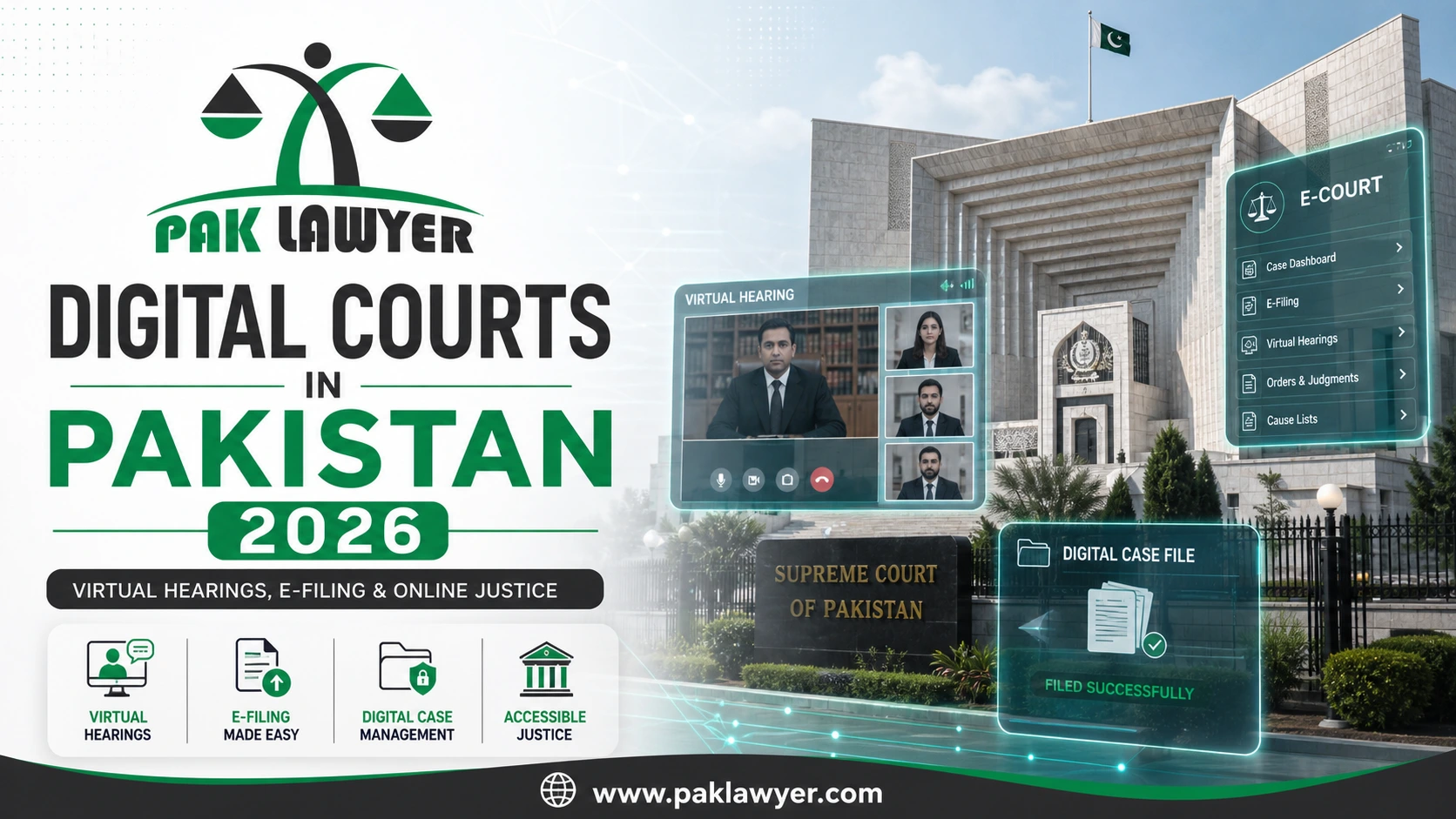
This transformation does not mean that traditional courts will disappear. Judges, lawyers, court staff, evidence, pleadings and procedural law will remain central to litigation. But technology is becoming an important support system. A case may still be decided by a judge in accordance with law, but the journey of that case—from filing to hearing to order transmission—can now be faster, more transparent and more accessible through digital tools.
The year 2026 is especially important because the Supreme Court of Pakistan has recently moved further into multi-location digital hearings. In April 2026, the Supreme Court reportedly used technology to bring together benches, lawyers and parties from different cities, with proceedings involving Islamabad, Quetta, Hyderabad, Karachi and Lahore. Reports also highlighted digitised case files, case barcoding, e-filing, digital payment systems, electronic transmission of judicial orders, video-link hearings and an e-office system as part of the wider digital justice ecosystem. (Dawn)
For a litigant, this shift raises practical questions: Can I check my case online? Can my lawyer appear through video link? Can a case be filed electronically? Will virtual hearings reduce legal costs? Can overseas Pakistanis participate in litigation without travelling to Pakistan? Will Digital courts in Pakistan 2026 reduce delays? And most importantly, will online court systems make justice more accessible for ordinary citizens?
This article explains the concept of digital courts in Pakistan 2026, the benefits and challenges of e-courts, and what litigants, lawyers, businesses and overseas Pakistanis should know before relying on digital justice systems.
What Are Digital Courts in Pakistan?
A Digital courts in Pakistan 2026 is not simply a courtroom with a camera. It is a technology-supported justice system where different stages of litigation are managed through electronic platforms. These may include online case filing, digital scrutiny of documents, electronic notices, online court fee payments, case tracking, digital cause lists, video-link hearings, e-orders, electronic certified copies, automated scheduling and digital court records.
In Pakistan, the phrase digital courts may refer to several connected developments. At the Supreme Court level, it may include multi-location hearings, digitised case files, case barcoding, e-filing, e-office systems, digital payments and electronic transmission of judicial orders. At the High Court and district court levels, it may include online case search portals, cause lists, SMS alerts, mobile applications, lawyer portals, e-court requests and online court proceedings. The Supreme Court’s official website also lists multiple case management services, including online case status, judgment search, cause list, cause list search, latest judgments, video link, roster of sittings and fortnightly disposal reports. (supremecourt.gov.pk)
In simple words, Digital courts in Pakistan 2026 are designed to reduce unnecessary physical movement, improve access to information, preserve court records, make scheduling more predictable and allow hearings to continue even when distance, travel, security or emergency situations create difficulties.
The idea is not limited to one court or one province. Different courts in Pakistan have adopted different systems. For example, the Sindh High Court website provides links for case search, e-filing through an e-services portal, advance case search, online court proceedings, cause lists, cases alert system and a mobile app. (sindhhighcourt.gov.pk) The Islamabad High Court has an online e-court system through which lawyers may request the e-court facility, subject to requirements such as providing a Microsoft Teams ID, observing dress code, verification of identity and not recording proceedings. (mis.ihc.gov.pk) Punjab’s Lahore High Court automation project, supported by PITB, includes electronic case filing, a lawyer’s e-filing portal, case file digitisation, rules-based case scheduling, online hearings, judges’ workbench, performance dashboards, SMS alerts and a mobile app. (pitb.gov.pk)
These examples show that Pakistan’s digital court landscape is developing in layers. Some systems are already public-facing, such as case search and cause lists. Others are internal administrative systems, such as e-office, digital files and court performance dashboards. Together, these systems form the foundation of e-justice in Pakistan.
Why Digital Courts in Pakistan Matter in 2026
Digital courts in Pakistan 2026 matter because the justice system affects almost every area of life: family disputes, inheritance matters, property cases, business conflicts, criminal bail, constitutional petitions, service matters, banking litigation, rent cases, tax disputes and overseas Pakistani legal issues. When the court process is slow, expensive or difficult to access, people lose faith in the system. When the process becomes more transparent, predictable and accessible, litigants are better able to protect their rights.
Pakistan has long faced the challenge of case backlog. Recent judicial statistics and media reporting based on Law and Justice Commission material indicate that millions of cases remain pending across Pakistan’s courts. One recent report stated that more than 2.36 million cases were pending as of December 31, 2024, with the majority in the district judiciary. (Minute Mirror) Earlier reporting on the Law and Justice Commission’s bi-annual judicial statistics also showed 2.26 million pending cases by the end of 2023, with a large share at the district judiciary level. (Dawn)
Technology alone cannot solve backlog. Courts still need judges, staff, infrastructure, better case management rules, timely appointments, responsible litigation practices, effective service of notices and better alternative dispute resolution. However, digital systems can help address some of the practical causes of delay. For example, a digitised file can reduce time spent locating records. Online cause lists can help lawyers and litigants plan appearances. Video-link hearings can reduce adjournments caused by travel difficulties. Electronic order transmission can reduce the waiting period for certified communication. Automated case fixation can make listing more transparent and less dependent on manual discretion.
This is why digital courts in Pakistan 2026 should be treated as more than a technology story. They are a rule-of-law story, an access-to-justice story and a legal reform story.
Supreme Court Digital Justice Reforms in 2026
The Supreme Court’s 2026 digital justice push is one of the most important developments in Pakistan’s legal sector. Reports in April 2026 stated that the Supreme Court had successfully conducted multi-location court hearings using modern technology. In one reported hearing, a bench sat in Islamabad while counsel joined from Quetta, Hyderabad and Karachi. The same reporting stated that Chief Justice Yahya Afridi participated from Islamabad while Justice Ayesha A. Malik joined remotely from Lahore. (Dawn)
The most important part of this development is not just the use of video conferencing. The broader reform package includes a move away from traditional paper books toward fully digitised case files, as well as case barcoding, digital case filing, electronic transmission of court orders, digital payment systems, institutionalised video-link hearings and an e-office system. (Dawn)
For lawyers, this means court preparation may increasingly require comfort with electronic briefs, scanned annexures, digital pagination, online filing rules and virtual hearing etiquette. For litigants, it means that some matters may be handled without the same level of travel burden that existed in the past. For overseas Pakistanis, it points toward a future where certain legal steps may become easier to coordinate through lawyers in Pakistan, especially where personal appearance is not mandatory.
Another important 2026 development is the discussion around new standard operating procedures for uninterrupted judicial work, including urgent matters and backlog reduction. Reporting stated that urgent civil and criminal matters would receive priority, including family cases, bail applications, criminal revisions, cases involving prisoners above the age of 80, restoration petitions, settlement matters and cases involving short legal questions. The same report mentioned steps such as including at least 40% oldest pending matters up to 2018 in each final cause list, special facilitation for lawyers from Sindh and Balochistan, and a proposed automated case fixation system with weekly and proposed monthly cause lists. (The Express Tribune)
This matters because digital justice is not only about convenience. It is also about fairness in listing, continuity of court work and reducing uncertainty for litigants.
Main Features of Digital Courts in Pakistan
1. Virtual Hearings and Video-Link Court Proceedings
Virtual hearings allow judges, lawyers and sometimes parties to participate in court proceedings through video conferencing or online platforms. This is one of the most visible parts of the e-court system. In Pakistan, video-link hearings have already been used by different courts, and the Supreme Court’s 2026 multi-city hearings show how this model can work across cities. (Dawn)
Virtual hearings are especially useful where lawyers are located in different cities, where travel is costly, where urgent relief is required, or where a party cannot easily attend in person. They can also support continuity during emergencies, unexpected holidays or logistical disruptions.
However, virtual hearings require discipline. Lawyers must be properly dressed, technically prepared and available on time. The Islamabad High Court’s e-court instructions, for example, require lawyers seeking e-court facility to provide relevant IDs, ensure availability on the communication platform, observe dress code, and avoid recording proceedings. The instructions also note identity verification before the case is called. (mis.ihc.gov.pk)
2. E-Filing in Pakistan Courts
E-filing means submitting petitions, applications, replies, documents and annexures through an electronic system instead of relying only on physical filing at the court counter. In practice, e-filing may still require compliance with court rules, payment of court fees, indexing, affidavits, signatures, scanning standards and scrutiny by the office.
E-filing is important because it can reduce queues, save travel time, make filing more transparent and help lawyers manage documents more efficiently. The Lahore High Court automation project includes electronic case filing and a lawyer’s e-filing portal. (pitb.gov.pk) The Sindh High Court also provides an e-filing link through its e-services portal. (sindhhighcourt.gov.pk) The Supreme Court’s 2026 digital reforms also refer to digital case filing as part of the court’s wider digitisation ecosystem. (Dawn)
For litigants, e-filing does not mean that anyone should file a case without legal advice. Court pleadings require proper drafting, jurisdictional analysis, limitation review, court fee assessment, annexure verification and procedural compliance. A poorly filed online case may still face objections, dismissal or delay. Therefore, e-filing Pakistan courts is best understood as a modern method of filing, not a substitute for professional legal work.
3. Online Case Status and Case Search
One of the biggest frustrations for litigants is not knowing what happened in court. Online case status helps solve this problem by allowing parties and lawyers to check case details, hearing dates, bench information and sometimes order status through court websites or mobile apps.
The Supreme Court website lists online case status and case management resources. (supremecourt.gov.pk) The Islamabad High Court FAQ explains that daily cause lists are uploaded on the website and that case details may be available through the official website and mobile application, including case category, case number, year, bench, case title, institution date, last hearing date and next hearing date. (mis.ihc.gov.pk) The Sindh High Court provides case search and advance case search links for the Principal Seat and circuit courts. (sindhhighcourt.gov.pk)
For SEO purposes, this is one of the most searched public-interest areas: online case status Pakistan, court case tracking Pakistan, how to check court case online in Pakistan, online cause list Pakistan and case management system Pakistan.
4. Digital Cause Lists
A cause list tells lawyers and litigants when a case is fixed, before which bench, and in what order or category. Digital cause lists make this information easier to access and reduce dependency on physical notice boards.
Digital cause lists are especially useful for outstation lawyers, overseas clients and parties who need to coordinate travel. They also reduce uncertainty for litigants who otherwise depend entirely on manual updates from court staff or lawyers.
The Supreme Court’s official website lists cause list and cause list search among its case management services. (supremecourt.gov.pk) The Islamabad High Court FAQ states that the daily cause list is uploaded on the website. (mis.ihc.gov.pk) The Sindh High Court homepage provides cause list links for Karachi, Hyderabad, Sukkur, Larkana, Mirpurkhas and other forums. (sindhhighcourt.gov.pk)
5. Digitised Case Files and Document Management
Traditional court files can become bulky, difficult to transport and vulnerable to misplacement or deterioration. Digitised case files allow judges and court staff to access scanned pleadings, annexures, orders and case history electronically. This improves internal court efficiency and reduces the need to requisition physical records from branch registries.
Dawn’s April 2026 report stated that the Supreme Court’s proceedings marked a shift away from physical paper books and that fully digitised case files were used during hearings, reducing the need to retrieve records from branch registries. (Dawn) PITB’s description of Lahore High Court automation also includes case file digitisation and document management as features of the system. (pitb.gov.pk)
For lawyers, digitised files require better document discipline. Every annexure should be legible, properly numbered, correctly indexed and relevant. Scanned documents should not be blurry, incomplete or improperly arranged. In a digital court environment, poor scanning can become the new version of poor drafting.
6. Case Barcoding and Tracking
Case barcoding helps identify and track case files, applications and documents more accurately. In a manual system, files may move between branches, benches, registries and copying departments. Barcode tracking can improve transparency by creating an electronic trail.
The Supreme Court’s 2026 reforms reportedly included case barcoding for precise tracking and transparency. (Dawn) This can be especially useful in courts with high filing volumes, multiple branch registries and frequent movement of records.
7. Electronic Transmission of Court Orders
A court order is useful only when it is communicated properly. In urgent matters—such as bail, custody, stay orders, service matters, banking issues or family disputes—delay in receiving an order can cause serious hardship.
The Supreme Court’s digital reforms reportedly include electronic transmission of judicial orders, enabling faster delivery of decisions. (The Express Tribune) This is a major development for litigants because it can reduce waiting time after a case is decided or an interim order is passed.
8. Digital Payment Systems
Court processes often involve payments, including court fees, copying fees and other official charges. Digital payment systems can reduce inconvenience, improve accountability and support online filing. The Supreme Court’s 2026 reform package reportedly included operationalised digital payment systems to simplify processes for litigants. (Dawn)
In the long run, digital payments can also reduce disputes about receipts, improve audit trails and support remote litigation services for overseas Pakistanis.
9. Automated Case Fixation and Scheduling
One of the most important future areas is automated case fixation. A transparent scheduling system can help reduce arbitrary delays and improve predictability. Reporting on the Supreme Court’s 2026 reforms mentioned plans for an automated case fixation system using algorithm-based prioritisation, along with weekly and proposed monthly cause lists. (The Express Tribune)
This is an important phrase for SEO and public interest: automated case fixation system Pakistan. If properly designed, such a system can help litigants understand when older cases, urgent matters or short legal questions may be listed.
However, automated scheduling must be transparent, reviewable and fair. Algorithms should support judicial administration, not replace judicial discretion where legal judgment is required.
Benefits of Digital courts in Pakistan 2026 for Litigants
The biggest benefit of Digital courts in Pakistan 2026 is access. Many litigants live far from the court where their case is pending. A person from Balochistan, interior Sindh, southern Punjab, Gilgit-Baltistan, Khyber Pakhtunkhwa or Azad Jammu and Kashmir may face heavy travel costs just to attend a hearing. A person living abroad may spend thousands of dollars to appear in Pakistan for a case update that could otherwise be handled through counsel or video link.
Digital courts in Pakistan 2026 can reduce this burden. Video-link hearings may allow outstation lawyers to argue without travelling. Online case status can help litigants check hearing dates. E-filing can reduce physical visits to filing counters. Digital orders can reduce the delay in receiving decisions. SMS alerts and mobile apps can help lawyers and parties stay informed.
Digital courts in Pakistan 2026 can also reduce dependence on informal updates. In a manual system, a litigant often has to call a lawyer, clerk, munshi or court staff member to ask, “What happened in my case?” In a digital system, at least some case information becomes publicly checkable through official portals.
For ordinary citizens, this can improve confidence in the justice system. A litigant may still be anxious about the result of the case, but they should not be left completely in the dark about the next date, bench, order status or filing stage.
Benefits for Lawyers and Law Firms
Digital courts in Pakistan 2026 do not reduce the importance of lawyers. In fact, they increase the need for technically competent lawyers who can combine legal knowledge with digital efficiency.
A modern lawyer in Pakistan now needs to understand drafting, advocacy, limitation, jurisdiction and evidence, but also PDF management, digital annexures, scanned records, e-filing portals, online cause lists, virtual hearing etiquette, digital signatures where applicable, online research and remote client communication.
For law firms, digital courts create an opportunity to build better systems. A professional law office should maintain digital case files, scanned pleadings, indexed annexures, calendar reminders, hearing notes, client communication logs and online case tracking. This is especially important for firms serving overseas Pakistanis, corporate clients or high-volume litigation.
The Lahore High Court automation project description notes that the lawyer’s portal enables lawyers to prepare and file cases online from homes and offices and that lawyers receive email and SMS notifications. (pitb.gov.pk) This shows how legal practice is moving toward a hybrid model: physical advocacy plus digital case management.
Lawyers who adapt early will have an advantage. They can respond faster, track cases better, communicate with clients more clearly and reduce administrative errors.
Digital Courts and Overseas Pakistanis
For overseas Pakistanis, digital courts are one of the most important legal developments. Many overseas Pakistanis face property disputes, inheritance matters, family cases, guardianship issues, divorce documentation, succession certificates, illegal possession, fraud, banking disputes and power of attorney problems in Pakistan. Traditionally, these cases required coordination across time zones, couriered documents, attested papers and sometimes repeated travel.
Digital justice can make this process easier. Online case status allows overseas clients to monitor progress. Video-link hearings may reduce unnecessary travel where personal appearance is not legally required. E-filing can help lawyers file urgent applications faster. Electronic orders can help parties receive updates more quickly. Digital payments may eventually make court-related expenses easier to manage.
However, overseas Pakistanis should not assume that every case can be handled entirely online. Some matters may still require notarised or consular-attested documents, biometric verification, original evidence, power of attorney, personal statements, cross-examination or appearance before a local authority. The exact requirement depends on the nature of the case and the court involved.
The best approach is to hire a lawyer who understands both court procedure and remote client service. The lawyer should explain which steps can be done online, which steps require physical documents and which steps require personal appearance.
Digital Courts in Family Cases
Family litigation is one of the areas where digital courts can make a real difference. Family disputes often involve sensitive issues such as divorce, khula, maintenance, custody, guardianship, visitation, dower, dowry articles and domestic conflict. For many parties, repeated court visits are emotionally and financially difficult.
Digital systems can help by providing online case information, clearer hearing schedules and potentially video-link participation in suitable cases. Reporting on the Supreme Court’s 2026 SOP-related reforms mentioned family cases among urgent civil and criminal matters to be prioritised. (The Express Tribune)
This does not mean every family case should become virtual. In family matters, judges may need to assess parties directly, encourage reconciliation where legally appropriate, protect minors, examine documents and ensure that vulnerable parties are not pressured. But digital tools can still reduce unnecessary delay and improve communication.
For example, an overseas Pakistani father or mother involved in a guardianship or custody issue may need to coordinate with counsel remotely. A wife seeking maintenance may need timely updates about hearing dates. A party in a khula case may need clarity about documents and orders. In all these situations, digital case tracking and online legal consultation can help.
Digital Courts in Bail and Criminal Matters
Bail matters are time-sensitive. Delay can affect personal liberty. Virtual hearings, electronic order transmission and prioritised listing of urgent criminal matters can therefore have serious practical importance.
Reports on the Supreme Court’s 2026 SOPs mentioned bail applications, criminal revisions and cases involving prisoners above the age of 80 among priority matters. (The Express Tribune) This is significant because criminal litigation often involves urgent liberty, custody or detention issues.
Digital tools can support criminal justice in several ways. Video-link hearings can help where counsel is in another city. Electronic orders can reduce delay in communicating bail orders. Digitised files can assist courts in quickly reviewing previous orders, FIRs, statements and procedural history. Online cause lists can help families and lawyers know when a matter is fixed.
At the same time, criminal cases require strong safeguards. Accused persons must have effective legal representation. Confidential lawyer-client communication must be protected. Evidence must be authentic. Proceedings must not prejudice the accused. Digital convenience should never weaken fair trial rights.
Digital Courts and Business Litigation
Businesses in Pakistan frequently face contract disputes, recovery suits, banking litigation, tax matters, regulatory notices, employment disputes, shareholder conflicts, intellectual property issues and commercial cases. For companies, delay means cost. It can freeze capital, affect business relationships and reduce investor confidence.
Digital courts can improve commercial litigation by making case scheduling more predictable, reducing travel, enabling faster filing, improving access to orders and helping lawyers manage large document volumes. Digital case files are particularly useful in commercial disputes because such cases often involve contracts, invoices, bank statements, emails, ledgers, board resolutions and correspondence.
Businesses should also pay attention to digital evidence. Commercial disputes increasingly involve emails, WhatsApp messages, online invoices, digital payments, electronic records and screenshots. Pakistan’s legal framework includes the Electronic Transactions Ordinance, 2002, which was enacted to recognise and facilitate documents, records, information, communications and transactions in electronic form. (Pakistan Telecommunication Authority) The Qanun-e-Shahadat Order, 1984 remains the core law of evidence listed in Pakistan Code. (Pakistan Code)
The practical lesson for businesses is simple: preserve digital records properly. Do not rely on random screenshots alone. Keep original emails, server records, payment receipts, invoices, contracts and metadata where possible. Consult a lawyer before submitting electronic evidence so that admissibility, authenticity and relevance are properly addressed.
Privacy, Data Protection and Cybersecurity Concerns
Digital courts require trust. If case files, identity documents, financial records, medical records, family documents or criminal case materials are uploaded online, courts and lawyers must protect that data. Cybersecurity is not a luxury; it is essential to digital justice.
Pakistan’s data protection framework is still developing. ICLG’s 2025–2026 Pakistan chapter states that Pakistan’s personal data protection legislation is still in draft or bill stage and has yet to be passed by Parliament, while PECA 2016 contains certain significant provisions about data protection. (ICLG Business Reports) Chambers’ 2026 Pakistan guide similarly notes that Article 14 of the Constitution recognises privacy as a fundamental right and that the Personal Data Protection Bill, 2023 had not yet been passed by both houses of Parliament. (Global Practice Guides)
For digital courts, this raises important questions. Who can access scanned case files? How are records stored? Are video hearings recorded? Who controls recordings? How are CNICs, addresses and personal documents protected? What happens if a court portal is hacked? How long are digital records retained? Can sensitive family or criminal records be publicly searched?
Courts will need strong cybersecurity protocols, access controls, audit logs, encryption, backup systems and clear rules on confidentiality. Lawyers also have responsibilities. A lawyer should not store client documents carelessly on unsecured devices, public email accounts or unprotected messaging apps. Law firms handling digital litigation should use secure document management practices.
Challenges Facing Digital Courts in Pakistan
Digital transformation is promising, but it is not easy. Pakistan’s digital courts face several challenges.
First, there is the digital divide. Not every litigant has reliable internet, a smartphone, a laptop or digital literacy. Rural litigants, elderly persons, low-income families and people with disabilities may struggle to use online systems. A justice system must not become accessible only to educated urban users.
Second, internet reliability remains a practical problem. A virtual hearing can fail if the lawyer’s connection drops, the court’s system crashes, the audio is unclear or electricity fails. Courts must have backup procedures so that technical problems do not unfairly harm a party.
Third, authentication is critical. Courts must know who is appearing online. The Islamabad High Court e-court instructions include identity and eligibility verification before a case is called. (mis.ihc.gov.pk) Similar safeguards are necessary everywhere.
Fourth, digital records must be accurate. A wrong scan, missing page or incorrect upload can create serious problems. Court staff and lawyers need training in scanning, indexing, uploading and verifying documents.
Fifth, procedural rules must evolve. Courts need clear rules on e-filing deadlines, electronic signatures, original documents, certified copies, digital evidence, service through electronic means, online affidavits, virtual cross-examination and recording restrictions.
Sixth, transparency must be balanced with privacy. Online access to case information is useful, but sensitive cases may require restrictions. Family, juvenile, sexual offence, medical, national security and confidential commercial matters may need special handling.
Seventh, lawyers and court staff require training. Technology can create more confusion if users do not understand it. Bar associations, judicial academies and court IT departments should provide regular training on e-filing, online hearings, digital evidence and cybersecurity.
How Litigants Should Prepare for a Virtual Court Hearing
A virtual hearing should be treated with the same seriousness as a physical court appearance. The fact that a lawyer or party appears through a screen does not make the proceeding informal.
Before a virtual hearing, the litigant should confirm the hearing date, court, bench, platform, login details and required documents with their lawyer. The internet connection should be tested. The device should be charged. The camera, microphone and speaker should work properly. The participant should sit in a quiet, respectful place with proper lighting. Documents should be available in digital and physical form.
No one should record court proceedings unless expressly permitted by the court. The Islamabad High Court e-court instructions specifically state that advocates or parties shall not record e-court proceedings or make them public, and may be proceeded against under applicable laws if they do so. (mis.ihc.gov.pk) This rule is important because court proceedings are not social media content. Unauthorized recording can violate court directions, privacy and professional ethics.
A party should not interrupt the judge or opposing counsel. They should speak only when asked, follow their lawyer’s advice and remain available until the matter is completed. If the connection fails, they should immediately inform their lawyer or the court contact point where applicable.
Practical E-Filing Checklist for Lawyers and Litigants
E-filing can save time, but only if documents are prepared correctly. A careless e-filing can create objections and delay the case.
A proper e-filing checklist should include the correct case category, jurisdiction, limitation analysis, memo of parties, CNIC or registration details where required, proper title, index, list of dates, grounds, prayer, affidavit, vakalatnama or power of attorney, annexures, court fee, scanned documents, certified copies where needed and compliance with court rules.
Each PDF should be readable. Pages should be straight, complete and properly numbered. Annexures should match the index. File names should be clear. Sensitive documents should be handled carefully. Lawyers should keep proof of submission, diary number, objection notes and payment receipts.
Litigants should understand that e-filing is not just uploading documents. It is a legal act. Wrong filing can create limitation issues, jurisdictional objections or procedural defects. Always consult a qualified lawyer before filing a case online.
Will Digital Courts Reduce Case Backlog?
Digital courts in Pakistan 2026 can help reduce backlog, but they are not a magic solution. Backlog is caused by many factors: shortage of judges, adjournments, procedural delays, poor service of notices, weak investigation, incomplete records, excessive litigation, frequent transfers, lack of case management, and sometimes unnecessary petitions or appeals.
Technology can reduce administrative delay. It can help courts find files, list cases, track old matters, send orders, manage cause lists and avoid unnecessary travel adjournments. The Supreme Court’s 2026 reforms reportedly include measures for backlog reduction, including prioritising older cases up to 2018 in final cause lists and planning an automated case fixation system. (The Express Tribune)
But the human element remains essential. Judges must actively manage cases. Lawyers must avoid unnecessary adjournments. Litigants must provide documents on time. Court staff must update systems accurately. Government departments must respond efficiently. Technology can support justice, but it cannot replace responsibility.
The Future of Digital Courts in Pakistan: 2026 and Beyond
The future of e-courts Pakistan will likely move toward integrated justice platforms. Ideally, a litigant should one day be able to file a case, pay court fees, receive objections, track case status, view cause lists, receive certified orders and coordinate hearings through a secure official system.
Artificial intelligence may also enter court administration, especially for cause list management, file classification, legal research support, transcription, translation and performance analytics. However, AI should be used carefully. It should assist administrative efficiency, not replace judicial reasoning. Any use of algorithmic scheduling must be transparent, auditable and fair.
Mobile apps will become more important. Many Pakistani litigants rely more on mobile phones than laptops. A good court app can provide hearing alerts, case status, cause lists, order updates and filing notifications. SMS alerts will also remain important for people without reliable smartphone access.
Another likely development is greater support for overseas Pakistanis. Courts and government bodies may expand online verification, video-link appearance and digital document processing. This would be especially useful in property, succession, family and civil litigation.
The most successful Digital courts in Pakistan 2026 model will be hybrid. Physical courts will remain necessary for trials, evidence, witness examination, complex arguments and cases where personal appearance is required. Digital tools will support filing, tracking, scheduling, document management and suitable hearings. The goal should not be “online only” justice. The goal should be accessible, efficient and trustworthy justice.
Frequently Asked Questions About Digital Courts in Pakistan 2026
1. What are digital courts in Pakistan 2026?
Digital courts are technology-supported courts where filing, case tracking, cause lists, hearings, documents, orders or payments may be managed electronically. They include e-filing, virtual hearings, online case status, digitised case files, electronic orders and court case management systems.
2. Can I check my court case online in Pakistan?
In many courts, yes. The Supreme Court, High Courts and several district court systems provide online case search or case status tools. Availability depends on the court and the type of case. The Supreme Court website lists online case status, judgment search, cause list and video link services, while the Islamabad High Court provides case details through its website and mobile application. (supremecourt.gov.pk)
3. Are virtual hearings allowed in Pakistan?
Yes, virtual hearings and e-court facilities are being used in different courts. The Supreme Court conducted multi-location hearings in 2026, and the Islamabad High Court has an online e-court system for lawyers seeking video-link facility. (Dawn)
4. Can overseas Pakistanis use digital courts?
Overseas Pakistanis can benefit from online case tracking, remote legal consultation, digital document coordination and, in suitable cases, video-link participation. However, some matters may still require physical documents, attestation, biometric verification or personal appearance depending on the law and court directions.
5. Is e-filing available in Pakistan courts?
E-filing is developing across different courts. The Lahore High Court automation project includes electronic case filing and a lawyer’s e-filing portal, the Sindh High Court provides an e-filing e-services portal, and the Supreme Court’s 2026 digital reforms include digital case filing. (pitb.gov.pk)
6. Can I record an online court hearing?
No, not unless the court expressly permits it. The Islamabad High Court e-court instructions state that advocates or parties shall not record e-court proceedings or make them public, and violation may lead to proceedings under applicable laws. (mis.ihc.gov.pk)
7. Will digital courts replace lawyers?
No. Digital courts change the method of filing, tracking and hearing cases, but legal advice, drafting, advocacy, evidence preparation and court strategy still require professional legal expertise.
8. Are digital court records safe?
Digital records can improve efficiency, but they also require strong cybersecurity, privacy rules and access controls. Pakistan’s comprehensive personal data protection legislation is still in draft or bill stage, so privacy and data protection remain important legal concerns. (ICLG Business Reports)
Conclusion: Digital Justice Is the Future, But Fairness Must Come First
Digital courts in Pakistan 2026 represent a major shift in the justice system. Virtual hearings, e-filing, online case status, digital cause lists, case barcoding, digitised case files, electronic orders, digital payments and automated scheduling can make litigation more accessible, transparent and efficient.
For litigants, digital courts can reduce travel, improve case tracking and make legal processes easier to understand. For lawyers, they create a new professional standard where legal skill must be combined with digital competence. For overseas Pakistanis, they offer hope that legal matters in Pakistan can be handled with less uncertainty and fewer unnecessary visits. For businesses, they can improve commercial dispute management. For the judiciary, they can support backlog reduction, better file control and more predictable scheduling.
But technology must serve justice, not replace it. Digital courts must protect fair trial rights, privacy, confidentiality, access for poor litigants and procedural fairness. A person without internet access should not be denied justice. A party with weak technology should not lose a case because of a technical failure. Sensitive records should not be exposed. Algorithms should not become invisible decision-makers. Court systems must remain transparent, accountable and human-centered.
The future of justice in Pakistan is not simply online. It is hybrid, accessible, secure and citizen-focused. The courts that succeed will be those that combine the authority of law with the efficiency of technology.
Legal note: This article is for general information only and should not be treated as legal advice. Court procedures, e-filing rules and virtual hearing requirements may vary by court and may change over time. For any specific case, consult a qualified lawyer in Pakistan.
