

The Triple Talaq — Pakistan’s Most Dangerous Legal Misconception in 2026
The Triple Talaq misconceptions, illegal Arbitration Council practices, and the complete guide for overseas Pakistanis — explained by a practicing advocate.
- Pakistanis facing divorce
- Overseas Pakistanis
- Union Council officials
- Embassy & Consulate staff
- Family lawyers & judges
- Legal aid workers
The Law — What Section 7 of MFLO 1961 Actually Says
The primary legislation governing divorce in Pakistan is the Muslim Family Laws Ordinance, 1961 (MFLO). Section 7 is the cornerstone provision. It is reproduced here so that every reader — whether layperson or official — may understand the exact language of the law.
(1) Any man who wishes to divorce his wife shall, as soon as may be after the pronouncement of talaq in any form whatsoever, give the Chairman a notice in writing of his having done so, and shall supply a copy thereof to the wife.
(2) Whoever contravenes the provisions of subsection (1) shall be punishable with simple imprisonment for a term which may extend to one year, or with fine which may extend to five thousand rupees, or with both.
(3) Save as provided in subsection (5), a Talaq, unless revoked earlier expressly or otherwise, shall not be effective until the expiration of ninety days from the day on which notice under subsection (1) is delivered to the Chairman.
(4) Within thirty days of the receipt of notice under sub-section (1), the Chairman shall constitute an Arbitration Council for the purpose of bringing about a reconciliation between the parties, and the Arbitration Council shall take all steps necessary to bring about such reconciliation.
(5) If the wife be pregnant at the time talaq is pronounced, talaq shall not be effective until the period mentioned in subsection (3) or the pregnancy, whichever be later, ends.
The language of Section 7 is unambiguous. It does not say two divorces, three divorces (the triple talaq), or any specific number. It says “talaq in any form whatsoever” — a single, clear pronouncement of divorce, followed by written notice to the Arbitration Council. That is all the law requires.
The Triple Talaq Myth — Pakistan’s Most Dangerous Legal Misconception
What the law says — and what people wrongly believe
Among the most widespread and damaging misconceptions in Pakistani family law is the belief that a husband must pronounce talaq three times (The Triple Talaq ) — issuing three separate divorce deeds on three separate occasions — for a divorce to be valid and for the Arbitration Council to process it.
This belief is factually, legally, and constitutionally wrong.
Under Section 7 of the Muslim Family Laws Ordinance, 1961, ONE valid pronouncement of talaq, duly communicated to the wife and followed by written notice to the Arbitration Council, is legally sufficient. No law, rule, regulation, or government notification requires The Triple Talaq . The 90-day period begins from the date the first notice is delivered to the Chairman — not from any third divorce.
How this misconception is actively harming citizens
Across Punjab and other provinces, Union Councils are routinely and illegally refusing to issue divorce certificates unless three separate divorce deeds are produced. This practice:
• Has no legal authority in MFLO 1961 or any rules thereunder
• Is not supported by any circular or notification of any provincial local government
• Causes immense hardship, confusion, and financial expense to ordinary citizens
• Keeps women trapped in legal limbo, unable to remarry or assert post-divorce rights
• Arises from a dangerous confusion between a minor administrative guideline and substantive divorce law
The stamp paper confusion — what the government actually said
The government did issue an administrative instruction stating that if a husband wishes to pronounce three talaqs, the stamp papers for each deed should not all be obtained on the same day. This was intended to discourage the dishonest practice of backdating three pre-written deeds to fabricate the appearance of a sequential process.
This guideline has been catastrophically misread by officials as a requirement that every divorce must proceed in three stages. That reading is entirely wrong. The instruction addressed a specific fraudulent practice around stamp paper procurement — it did not alter Section 7. One divorce is one divorce. It is complete, valid, and effective.
Any Union Council or Arbitration Council official who demands The Triple Talaq deeds before processing a notice or issuing a certificate has no legal authority to impose that condition. Document the refusal and seek legal redress through the High Court via Constitutional Petition under Article 199 of the Constitution of Pakistan. Contact Pak-Lawyer Associates at www.paklawyer.com.
The Correct Legal Procedure for Pronouncing Talaq in Pakistan
The following is the complete, lawful step-by-step procedure for pronouncing and completing a talaq in Pakistan, as mandated by Section 7 of MFLO 1961 and clarified by the superior courts:
Illegal Practices by Arbitration Councils — and How They Harm Citizens
Many Union Councils refuse to conduct hearings or issue certificates when the husband does not appear. This is unlawful. The Chairman’s role is ministerial, not adjudicatory. After 90 days, the divorce becomes effective by operation of law — regardless of whether either party appears before the council.
As established above — this demand has no basis in law whatsoever. The Lahore High Court has unequivocally held that any deficiency in following Section 7 procedures does not invalidate the talaq, and the Chairman has no authority to examine the validity of the divorce or demand specific formats or numbers of divorces.
If an Arbitration Council refuses to issue your divorce certificate because your husband has not appeared, or because fewer than the triple talaq were issued — this refusal is illegal. The divorce may still be legally effective. Consult a qualified family lawyer immediately. You have the right to file a Constitutional Petition before the High Court to compel issuance of the certificate.
Divorce from Abroad — The Rights of Overseas Pakistanis
Millions of Pakistanis live and work abroad. Their marriages are registered in Pakistan. When those marriages break down, they face a legal maze that no law actually creates — only official ignorance and bureaucratic obstruction.
The Government of Pakistan authorised officers of Pakistani Missions abroad to discharge all the functions of the Chairman, Arbitration Council under the MFLO 1961. This means a Pakistani husband or wife living in the UK, UAE, USA, Canada, or elsewhere may initiate divorce proceedings directly through the Pakistani Embassy or Consulate in that country.
Step-by-step procedure for overseas divorce — as laid down by the Lahore High Court
The Lahore High Court in Writ Petition No. 6782 of 2019/BWP (Mst. Asma Bibi v. Chairman Reconciliation Committee, PLD 2020 679) has comprehensively established the procedure:
Illegal Practices by Pakistani Embassies Abroad
Despite clear law and binding court directions, Pakistani Missions abroad continue to obstruct the very citizens they are duty-bound to serve. The following documented illegal practices persist:
Several Pakistani Missions have adopted the position that they can only attest a Special Power of Attorney and cannot process a divorce deed. This contradicts the express terms of SRO 1086(K)/61 and multiple Lahore High Court judgments which vest Mission officers with full authority of a Chairman, Arbitration Council.
Despite clear directions from the Lahore High Court that Mission officers must function as Chairman, Arbitration Council for overseas Pakistanis, the vast majority of Pakistani Embassies have no functioning reconciliation mechanism whatsoever. Citizens who approach Embassies for divorce proceedings are routinely turned away — in direct defiance of judicial authority.
As per SRO No. 1086(K)/61 and multiple High Court judgments — including PLD 2019 Lahore 285 and PLD 2020 Lahore 679 — Pakistani Embassies and Consulates are legally obligated to maintain a functioning reconciliation mechanism for overseas Pakistanis. The Ministry of Foreign Affairs and Ministry of Overseas Pakistanis must urgently enforce compliance with these judicial directions.
Key Judicial Precedents — The Courts Have Spoken
The superior courts of Pakistan have been consistent and unambiguous. The following judgments represent binding precedent on every aspect of divorce law discussed in this article:
Recommendations — Fixing a Broken System
One talaq is sufficient. Notice to the Arbitration Council is mandatory. The role of the Arbitration Council is conciliatory — not adjudicatory. It cannot grant or refuse a divorce.
What is failing Pakistanis is not the law — it is the ignorance and illegal practices of those charged with implementing it. Every Pakistani, whether residing in Lahore or London, in Karachi or Canada, deserves to have their legal rights respected and enforced. This article is Pak-Lawyer Associates’ commitment to that cause.
Frequently Asked Questions
Is triple talaq valid in Pakistan?
The Triple talaq is not treated as instantly final under the current Supreme Court position. Section 7 applies to all forms of talaq, and the divorce does not become effective before the 90-day statutory period after notice to the Chairman.
Is one talaq enough for divorce in Pakistan?
One pronouncement is enough to start Section 7 proceedings. The law does not require three separate divorce deeds ( The Triple Talaq) or three separate stamp papers.
Can a husband divorce through WhatsApp in Pakistan?
A WhatsApp message may become evidence of pronouncement if proved, but the husband must still send written notice to the Chairman/Union Council and provide a copy to the wife.
Can Union Council demand the triple talaq before issuing certificate?
A demand for the triple talaq merely as a condition for processing the case is not supported by Section 7. The Union Council should process a valid notice of talaq and proceed with reconciliation.
When does divorce become effective?
Usually after 90 days from delivery of notice to the Chairman, unless revoked earlier. If the wife is pregnant, effectiveness may be delayed until the pregnancy ends if that is later.
Can talaq be withdrawn?
Yes. Talaq can be expressly or impliedly revoked before expiry of the 90-day period. The Supreme Court has also applied this right to a wife exercising an unconditional delegated right of divorce.
Who issues the divorce certificate in Pakistan?
The concerned Union Council / Arbitration Council issues the divorce effectiveness certificate, often referred to in practice as the NADRA divorce certificate or computerized divorce certificate.
What is the procedure for overseas Pakistani divorce?
Depending on the facts, the husband may proceed through a Pakistan Mission abroad, or through a duly authorized attorney before the competent Union Council in Pakistan. If a foreign court has already dissolved the marriage, Pakistani recognition may require consideration under Section 13 CPC and the competent Arbitration Council’s certificate process.
Pak-Lawyer Associates
Gull Hassan Khan Advocate | CEO | Family & Corporate Law | Lahore, Pakistan | Practising since 2009
Serving clients in Pakistan and overseas. For consultations regarding divorce, family law, and overseas legal matters.
© 2026 Pak-Lawyer Associates. All rights reserved. This article is published for legal awareness and educational purposes only and does not constitute formal legal advice. The legal positions expressed are based on Pakistani law as interpreted by the superior courts cited herein.

Rising Divorce Cases in Pakistan 2026: Legal Causes, Social Factors, Statistics & Expert Family Law Analysis
By Gull Hassan Khan
Advocate High Court | Family Laws Expert
Introduction: A Growing Legal and Social Crisis in Pakistan
The sharp increase in divorce cases across Pakistan has transformed from a sporadic social issue into a pressing legal and societal crisis. In the last ten to fifteen years, Family Courts in major urban centers such as Lahore, Karachi, Islamabad, and Peshawar have recorded a consistent and dramatic surge in the number of Khula petitions, Talaq cases, and other matrimonial disputes.
From the perspective of an active family law practitioner appearing before the High Court and Family Courts, this trend is far more than a simple rise in litigation numbers. It represents a profound shift in societal attitudes, changing marital expectations, greater awareness of legal rights, and the evolving dynamics of modern Pakistani families.
As an Advocate with extensive experience in family matters, I have personally witnessed that the rising divorce cases in Pakistan are the result of multiple interconnected factors. These include improved legal accessibility for women seeking Khula, rapid social transformation, persistent economic instability, the pervasive influence of digital technology, and a gradual breakdown in traditional family support systems.
What was once considered a rare and stigmatized event has now become increasingly normalized in many segments of society, particularly in urban and semi-urban areas.
Legal Framework Governing Divorce and Khula in Pakistan
To fully understand the phenomenon of rising divorce cases in Pakistan, it is crucial to examine the existing legal structure that regulates marriage dissolution.
The primary laws dealing with divorce and family matters in Pakistan are:
1. Muslim Family Laws Ordinance, 1961
This landmark legislation continues to serve as the backbone of family law in the country. Section 7 specifically deals with the procedure for Talaq (divorce pronounced by the husband). It mandates that the husband must send a written notice to the Chairman of the Union Council and provide a copy to the wife. A mandatory reconciliation period of 90 days is enforced during which the Union Council attempts to bring the parties together. Only after this period can the divorce become effective.
2. Dissolution of Muslim Marriages Act, 1939
This Act empowers a Muslim woman to seek judicial divorce (commonly known as Khula or Faskh-e-Nikah) on various grounds. These include cruelty (physical or mental), failure to provide maintenance (Nafaqa), husband’s disappearance for four years, imprisonment of the husband, impotency, and other recognized grounds. The Act has played a pivotal role in empowering women to exit toxic or incompatible marriages.
3. Family Courts Act, 1964
This law establishes a specialized forum for the speedy resolution of family disputes. It aims to ensure that matrimonial cases are decided expeditiously, often within six months, although heavy caseloads frequently cause delays in practice.
4. Constitutional Safeguards
Article 35 of the Constitution of Pakistan explicitly states that the State shall protect the marriage and the family as fundamental institutions of society. However, the current surge in divorce filings indicates that this constitutional obligation is facing significant practical challenges due to changing social realities.
These legal provisions have collectively made divorce more accessible, particularly for women, which is one of the key reasons behind the rising number of cases.
Statistical Trends and Evidence of Rising Divorce Cases in Pakistan
Although Pakistan still does not maintain a comprehensive, centralized national database on divorce statistics, data gathered from Family Courts, Union Councils, and reports from various provincial governments paint a concerning picture about Rising Divorce Cases in Pakistan.
There has been a significant rise in Khula filings initiated by women in recent years. Family Courts in metropolitan cities are now handling dozens of fresh cases every single day. Urban areas consistently report much higher divorce ratios compared to rural regions. Legal practitioners observe that what used to be considered exceptional cases have now become routine matters in the courts.
The data emerging from courts and research studies clearly reflects a surge:
- Divorce rates have increased by approximately 35% in the last five years
- In Lahore alone, 5,500+ khula cases were filed within 8 months
- In Rawalpindi, over 10,000 divorce cases were filed in a single year
- Karachi saw nearly 15,000 women seeking khula in one year
- Courts are now receiving 5–20 new family cases daily
Judicial observations indicate that women are initiating more divorce proceedings than men, reflecting a major societal transformation.
This upward trend is visible not only in big cities but is gradually spreading to smaller towns and even some rural districts, signaling a nationwide transformation in marital stability.
Judicial Observations and Insights from the Legal Community about Rising Divorce Cases in Pakistan 2026
Senior judges and experienced members of the bar have repeatedly highlighted several common themes during court proceedings and legal seminars:
– The rapid breakdown of mutual trust and tolerance between spouses
– The growing culture of suspicion (known locally as “shaak”) and baseless allegations
– Increasing reliance on digital evidence such as WhatsApp chats, Facebook messages, Instagram stories, and TikTok videos
– The weakening of traditional family mediation mechanisms
Many judges have openly remarked that Family Courts are increasingly being forced to act as institutions for resolving deep-rooted social breakdowns rather than merely adjudicating pure legal disputes. This shift places an enormous burden on the judiciary due to Rising Divorce Cases in Pakistan
Major Causes Behind the Rising Divorce Cases in Pakistan
After handling hundreds of family cases, I have identified the following key factors contributing to this alarming trend and reason of Rising Divorce Cases in Pakistan:
1. Love Marriages and Post-Marriage Reality Check
The growing popularity of love marriages has emerged as one of the most significant contributors to rising divorce cases in Pakistan. Many such marriages are based primarily on emotional attraction and limited pre-marital interaction. Once the honeymoon phase ends, couples often discover serious incompatibilities in financial habits, lifestyle choices, family values, and long-term goals. The absence of proper family involvement and due diligence before marriage frequently leads to early disillusionment and subsequent Khula petitions.
2. Conflicts within the Joint Family System
Pakistan’s traditional joint family structure, while culturally valuable, often becomes a major source of friction. Interference by in-laws, power struggles over household authority, lack of personal privacy, and differing expectations between the couple and extended family members frequently escalate into full-blown legal battles. In many Khula suits, the core dispute is not between husband and wife alone, but between two entire families.
3. Economic Instability and Financial Disputes
Persistent inflation, rising unemployment, and economic uncertainty have placed immense pressure on young couples. Failure to provide adequate maintenance (Nafaqa), disputes over financial control, and inability to meet basic household expenses are frequently cited as grounds for dissolution. Under Pakistani law, a husband is legally obligated to maintain his wife and children according to his financial capacity. Persistent failure in this duty remains a strong legal ground for Khula under the 1939 Act.
4. Impact of Mobile Phones and Social Media
The widespread use of smartphones and social media platforms (WhatsApp, Facebook, Instagram, TikTok, and Snapchat) has introduced entirely new challenges in marital relationships. Secret chats, emotional or virtual affairs, sharing of private photos and videos, and excessive time spent online have become common triggers for suspicion and conflict. Courts are now regularly confronted with digital evidence in the form of screenshots, call records, and social media posts, which often accelerate the breakdown of marriages.
5. Cheating, Extra-Marital Affairs, and Character Assassination
Physical infidelity, online emotional affairs, and even unproven allegations of immoral character continue to destroy marriages. In conservative Pakistani society, even rumors or suspicions of an affair can cause irreparable damage to a relationship, often leading to immediate legal proceedings.
6. Misunderstandings, Ego Clashes, and Poor Communication
A surprisingly large number of divorce cases stem from seemingly minor issues that escalate due to lack of communication, stubbornness, and emotional immaturity. Many couples lack the necessary emotional intelligence and conflict-resolution skills to navigate everyday disagreements. In such cases, even when strong legal grounds are absent, courts sometimes recognize the “irretrievable breakdown of marriage” and grant relief to prevent further suffering.
7. Women Empowerment and Greater Legal Awareness
Increased access to education, financial independence, and legal awareness among women has played a transformative role in Rising Divorce Cases in Pakistan. Today, many women are well-informed about their right to seek Khula without the husband’s consent. Courts generally prioritize a woman’s free will and personal dignity, making it easier for them to exit unhappy marriages.
8. Domestic Violence and Toxic Marital Environments
Physical, emotional, and psychological abuse remains a serious and legally recognized ground for dissolution. Pakistani courts have adopted a strict stance that no marriage should continue at the expense of a person’s physical safety or mental well-being.
Legal Process of Khula in Pakistan – Step by Step
In the context of rising divorce cases, it is important to understand the standard Khula procedure:
– Filing of a suit in the concerned Family Court under the Family Courts Act, 1964
– Issuance of summons/notice to the husband
– Court-directed reconciliation efforts (usually through a mediator or judge)
– Recording of the wife’s statement clearly expressing her aversion to continuing the marriage
– Passing of a decree for dissolution of marriage (Khula decree)
It is important to note that a certified copy of the Nikah Nama is helpful but not always mandatory at the initial filing stage. It can later be obtained from the relevant Union Council.
Impact of Rising Divorce Cases in Pakistan
The consequences of this trend extend far beyond the couples involved:
On Children: Psychological trauma, custody battles, visitation disputes, and long-term emotional effects on the mental health of minors.
On Society: Gradual weakening of the family as the basic social unit, increased social stigma in some communities, and higher litigation rates.
On Judiciary: Overburdened Family Courts leading to delays in case disposal and strain on the overall justice system.
Expert Legal Opinion – Recommendations and Way Forward
As a family law specialist, I strongly recommend the following practical measures to address this growing challenge:
1. Mandatory Pre-Marital Counseling
Counseling sessions should be institutionalized before marriage registration to help couples understand realistic expectations and responsibilities.
2. Strengthening Mediation and Alternative Dispute Resolution (ADR)
Family Courts should actively promote mediation at every stage to encourage amicable settlements and reduce unnecessary litigation.
3. Promoting Digital Responsibility in Marriages
Couples should openly discuss and mutually agree upon healthy boundaries regarding social media usage and online interactions.
4. Balanced Legal Awareness
While legal rights must be protected, they should not be misused as tools for harassment, revenge, or undue pressure.
5. Reforming the Role of Extended Families
Families must learn to act as pillars of support rather than sources of interference and conflict in the marital lives of young couples.
Conclusion:
The rising divorce cases in Pakistan represent a complex intersection of modern legal rights, evolving social norms, economic challenges, and technological influences. While Pakistani family law provides accessible remedies, strong protection for women’s rights, and efficient legal mechanisms through Khula and other provisions, the ultimate solution lies outside the courtroom.
Building stronger relationships based on mutual respect, open communication, emotional maturity, and shared responsibility remains the most effective way to preserve the sacred institution of marriage.
As legal professionals, our responsibility extends beyond winning cases in court. We must strive to save marriages wherever it is possible and in the best interest of the families involved, especially when children are part of the equation.
About the Author
Gull Hassan Khan
Advocate High Court | CEO, Pak-Lawyer Associates
Specialist in Family Laws of Pakistan
Need Legal Help?
If you or someone you know is facing marital difficulties, contemplating Khula, dealing with divorce proceedings, child custody issues, or maintenance disputes, professional legal guidance can make a significant difference.
Contact Pak-Lawyer Associates today for confidential, experienced, and result-oriented legal assistance in all family law matters.

Khula in Pakistan Without Husband Consent (Latest Supreme Court Law 2026)
Introduction:
One of the most searched legal questions today is:
👉 “Khula in Pakistan without husband consent – is it possible?”
The answer under Pakistani law is clear:
⚖️ Yes — Khula in Pakistan can be granted without the husband’s consent.
However, the legal logic must be understood:
👉 A woman approaches the court only when the husband refuses to give divorce.
👉 Otherwise, there is no need to go to court.
This is why the law empowers a Family Court / Qazi to dissolve the marriage where reconciliation fails.
What is Khula in Pakistan Without Husband ?
Khula in Pakistan is a judicial dissolution of marriage initiated by a woman, governed by:
- Dissolution of Muslim Marriages Act, 1939 (DMMA)
- Family Courts Act, 1964
- Islamic principles of Khula
It applies where:
- Husband refuses to give Talaq
- Marriage becomes unbearable
- Wife cannot live within the limits prescribed by Islam
Core Legal Principle
✔ Husband agrees → No need for Khula
✔ Husband refuses → Wife files Khula
👉 Therefore:
Khula in Pakistan exists because the husband refuses divorce — otherwise, court intervention is not required.
👉 In such cases, the Judge (Qazi) pronounces dissolution of marriage (Khula decree).
Khula in Pakistan Without Husband
Latest Supreme Court Law & Judicial Developments (2023–2026)
1. Khula is an Independent Right (No Husband Consent Required)
Pakistani jurisprudence firmly establishes that:
⚖️ A woman can obtain Khula in Pakistan without husband’s consent
📌 Authority:
- Khurshid Bibi v. Baboo Muhammad Amin (PLD 1967 SC 97)
2. Khula Cannot Be Imposed by Court (PLD 2024 SC 645)
In Ibrahim Khan v. Mst. Saima Khan, the Supreme Court held:
- Khula cannot be imposed by the court without the wife’s consent
- Courts must respect the autonomy and free will of women
- Judicial language must avoid patriarchal stereotypes
- A wife may get Khula in Pakistan Without Husband’s consent
👉 This is a landmark 2024 precedent shaping family law jurisprudence.
3. Dissolution Claims Under DMMA Must Be Decided on Evidence
In Hamad Hassan v. Mst. Isma Bukhari, the Supreme Court clarified:
- Claims under DMMA 1939 must be assessed on balance of probabilities
- Maintenance is a statutory obligation of the husband during marriage
4. Courts Must Protect Women’s Dignity and Autonomy
The Supreme Court emphasized:
- Courts must avoid gender-biased reasoning
- Women’s dignity, autonomy, and lived realities (including domestic abuse) must be recognized
- Khula and dissolution are distinct legal remedies
Grounds for Dissolution of Marriage (Under DMMA 1939)
Under Section 2 of the Dissolution of Muslim Marriages Act 1939, a woman is entitled to dissolution on multiple grounds:
Key Grounds Include:
✔ Failure to Provide Maintenance
- Husband neglects or fails to maintain wife for 2 years
✔ Unauthorized Second Marriage
- Husband contracts another marriage in violation of:
- Muslim Family Laws Ordinance 1961
✔ Cruelty (Broad Interpretation)
Cruelty includes:
- Physical abuse or habitual assault
- Making wife’s life miserable (even without physical violence)
- Association with immoral conduct
- Forcing immoral life
- Disposing of wife’s property
- Preventing religious practice
- Unequal treatment among multiple wives
📌 Courts have expanded cruelty to include psychological and emotional abuse
Supporting Case Law on Grounds
- Muhammad Shariful Islam v. Suraya Begum
- Shahana Bibi v. Nadeem Shah
- Rabia Rasheed v. Faisal Mir
👉 These cases confirm that cruelty, non-maintenance, and inequitable treatment justify dissolution.
Important Legal Distinction (Very Critical)
⚖️ The Supreme Court clarified:
👉 Dissolution under DMMA ≠ Khula
- Dissolution → Based on legal grounds (fault-based)
- Khula → Based on wife’s unwillingness (no fault required)
📌 Courts cannot convert dissolution into Khula without wife’s consent
Implications of Latest Supreme Court Law
This evolving jurisprudence has major implications:
✔ Strengthens women’s constitutional rights
✔ Recognizes domestic abuse realities
✔ Rejects patriarchal judicial language
✔ Protects financial rights (dower & maintenance)
✔ Establishes clear legal standards for future cases
👉 These rulings promote fair and dignified treatment of women in marriage disputes.
Conclusion of Legal Position
The Supreme Court has firmly settled that:
- A woman has a statutory and constitutional right to seek dissolution
- Khula cannot be forced by the court
- Dissolution cannot be converted into Khula without consent
- Courts must ensure justice, dignity, and equality
📌 Therefore:
Where the husband refuses divorce, the court (Qazi) dissolves the marriage — either through Khula or statutory dissolution under DMMA 1939.
Procedure of Khula in Pakistan Without Husband: (Quick Overview)
- File suit in Family Court
- Notice issued to husband
- Reconciliation attempt
- Wife’s statement recorded
- Court grants decree
- Union Council issues divorce certificate (after 90 days)
for more details watch Khula in Pakistan – Complete Legal Procedure
Why Choose Pak-Lawyer Associates?
✔ Expertise in Khula & Dissolution cases
✔ Overseas client handling (UK, USA, Europe)
✔ Complete legal process (Court + UC + NADRA)
✔ 18+ years experience
📞 +92 321 4610092 | +44 7417 528692
🌐 www.paklawyer.com

Pak-ID App POC Problems in Pakistan 2026
(Complete Guide for Foreign Spouses)

The Pak-ID App launched by NADRA was introduced to simplify identity services such as CNIC, NICOP, and POC.
However, in 2026, the reality is quite the opposite.
The Pak-ID App POC problems for foreign spouses has become one of the most common complaints faced by overseas Pakistani families.
What is POC Card in Pakistan?
A Pakistan Origin Card (POC) allows foreign nationals (especially spouses of Pakistani citizens) to:
- Enter Pakistan without visa
- Live and work in Pakistan
- Purchase property
- Open bank accounts
Despite its importance, obtaining a POC through the Pak-ID App has become extremely difficult.
🚨 Major Pak-ID App POC Problems (2026)
-
Single Device Login Restriction – A Practical Impossibility for Overseas Couples
The Pak-ID App is designed in a way that permits only one active login session per account on a single mobile device.
Practical Implications:
- Both spouses (Pakistani citizen and foreign spouse) are required to be physically present at the same location to complete the application.
- In most real-life scenarios, spouses are residing in different countries due to immigration, employment, or visa restrictions.
- The foreign spouse must repeatedly obtain a visa for Pakistan, which involves time, cost, and uncertainty.
Legal & Practical Concern:
This restriction ignores the realities of cross-border marriages and effectively blocks access to POC services for genuine applicants, making the entire process impractical, burdensome, and in many cases impossible to complete.
2. Biometric & Fingerprint Failure – A Systemic Technical Breakdown
The application requires users to submit:
- Live biometric facial photograph
- Digital fingerprint impressions through mobile devices
Ground Reality:
- Fingerprints are frequently rejected without clear justification
- Facial images are repeatedly flagged for:
- Lighting issues
- Angle issues
- Resolution concerns
- Many mobile devices are not compatible with accurate biometric capture
Result:
Applicants are trapped in a continuous rejection loop, despite submitting correct data multiple times.
Conclusion:
This reflects a serious flaw in system design, where advanced biometric requirements have been imposed without ensuring technical feasibility for ordinary users. It is rightly considered one of the most critical NADRA POC issues in 2026.
3. Absence of Proper Document Guidance – Procedural Ambiguity
A fundamental requirement of any administrative system is clarity of documentation requirements. Unfortunately, the Pak-ID App lacks:
- A structured document checklist
- Clear categorization of required documents
- Guidance on format, attestation, or verification
Instead, users receive vague objections such as:
- “Upload required documents”
- “Submit affidavit”
Critical Issue:
- No indication of:
- Which specific document is missing
- What type of affidavit is required
- Whether notarization or attestation is needed
Impact:
This creates, Pak-ID App POC Problems, procedural confusion, forcing applicants to make repeated submissions without understanding the deficiency—resulting in delays, frustration, and unnecessary rejections.
4. Ineffective Complaint Handling Mechanism – No Real Redressal
An efficient complaint system is essential for resolving user issues. However, in practice:
User Experience:
- Complaints are responded to with generic, copy-paste replies
- No case-specific analysis or feedback
- No follow-up or resolution tracking system
Key Deficiencies:
- Absence of escalation mechanism
- Lack of technically trained support staff
- No accountability framework
Outcome:
Even after multiple complaints, Pak-ID App POC Problems, applicants receive no meaningful assistance, leaving them without any effective remedy.
5. High Fee Structure Without Corresponding Service Delivery
The fee for a POC application typically ranges between:
💰 USD $150 – $250
Expectation:
Given the premium fee, applicants reasonably expect:
- Efficient processing
- Technical support
- Timely resolution
Reality:
- No dedicated support channel
- No facilitation for complex cases
- No priority handling despite delays
Legal Perspective:
Charging substantial fees without providing adequate service raises concerns regarding:
- Administrative fairness
- Consumer rights
- Accountability of public authorities
6. Missing Data Acquisition Form (DAF Issue)
In many cases, NADRA asks for:
👉 Data Acquisition Form (DAF)
But:
- Not available on Pak-ID App
- Not available on NADRA website
This reflects serious system mismanagement & Pak-ID App POC Problems.
(Download here) POC acquisition Form
_______________________________________________________
7. Continuous Rejection Loop
Real client case:
- 100+ attempts made
- Same objections repeated
- 4 months delay
- No final resolution
This is a major Pak-ID App problem affecting foreign spouses.
⚖️ Legal Concerns & Administrative Failures
From a legal perspective, the system raises serious issues:
- Lack of transparency
- No defined procedure
- Arbitrary objections
- No appeal mechanism
Pak-ID App POC Problems may fall under administrative arbitrariness and denial of due process.
🔄 Old System vs Pak-ID App
| Feature | Old System | Pak-ID App |
|---|---|---|
| Biometric | Physical | Mobile (faulty) |
| Guidance | Clear | Missing |
| Support | Available | Weak |
| Success Rate | High | Low |
🏛️ Required Action by Authorities
The Ministry of Interior and NADRA must:
- Allow dual-location verification
- Restore embassy/physical support
- Fix biometric system
- Provide document checklist
- Improve complaint handling
🌍 Impact on Overseas Pakistanis & Foreign Spouses
Thousands of families are affected:
- Delays in residency
- Immigration complications
- Family separation
Foreign spouses who trust Pakistan face unnecessary hardship.
📢 Conclusion
The Pak-ID App POC problem is no longer a minor technical issue—it is a national administrative concern.
Immediate reforms are required to:
✔ Protect overseas Pakistanis
✔ Facilitate foreign spouses
✔ Restore confidence in NADRA
📞 Need Legal Help?
Facing issues with Pak-ID App POC Problems
- POC for foreign spouse
- NICOP / CNIC
- NADRA objections
Pak-Lawyer Associates provides expert legal assistance for overseas Pakistanis.
📧 ask@paklawyer.com
📞 +92 321 4610092
🌐 www.paklawyer.com

Court Marriage in Pakistan for Immigration (2026 Step-by-Step Guide)
Court Marriage in Pakistan for Immigration is a legal and Sharia-compliant way of marriage conducted with free consent of both parties. It is commonly used by couples who wish to marry independently, avoid delays, or require proper documentation for visa, immigration, or NADRA records.
At Pak-Lawyer Associates, we provide complete court marriage services under one roof, ensuring that every legal formality is handled professionally—without errors, delays, or future complications.
What is Court Marriage in Pakistan?
Court marriage refers to a marriage solemnized under Islamic law (Nikah) with legal documentation, attestation, and registration, ensuring that the marriage is fully valid in Pakistan and acceptable internationally.
Complete Court Marriage Procedure;
For court marriage in Pakistan for immigration purposes, we adopt a strict, compliance-based legal procedure to eliminate any errors that may create issues in future visa or immigration matters in the UK, Europe, or the USA.
1. Verification of Documents
- CNIC copies of bride and groom
- Two witnesses (with CNIC copies)
- Marital status confirmation (unmarried/divorced/widowed)
2. Drafting of Nikah Nama
- Proper preparation of Nikah Nama (marriage contract)
- Inclusion of Haq Mehr, conditions, and rights clauses
- Ensuring no overwriting or legal defects
3. Nikah Ceremony
- Conducted by licensed Nikah Khawan
- Offer & acceptance (Ijab-o-Qabool) in presence of witnesses
- Immediate signing of Nikah Nama
4. Legal Documentation & Affidavits
- Free will affidavit of bride
- Additional legal declarations (if required)
5. Union Council Registration
- Submission of Nikah Nama for official registration
- Issuance of Computerized Marriage Certificate
6. NADRA Record Update
- Marriage reflected in NADRA system (where applicable)
How Pak-Lawyer Associates Handles Everything
At Pak-Lawyer Associates, we complete 100% of the procedure in our office for court marriage in Pakistan for immigration, including, Complete legal guidance before marriage
- Proper Nikah Nama drafting (immigration-compliant)
- Arrangement of Nikah Khawan & witnesses (if required)
- Immediate documentation and attestation
- Union Council registration follow-up
- NADRA compliance support
👉 This means no hassle, no running between offices, and no legal risks.
Common Mistakes by Inexperienced Law Firms
Choosing an inexperienced or unprofessional service provider can create serious legal and immigration issues. Some common problems include:
❌ 1. Non-Registration of Marriage
- Many firms only perform Nikah but fail to register it with Union Council
- Result: Marriage is not legally recognized for official use
❌ 2. Online Marriage Issues
- “Online Nikah” or proxy marriages are often:
- Not accepted by foreign embassies
- Problematic for visa/immigration cases (UK, Europe, USA)
- Without proper legal structure, such marriages may be rejected abroad
❌ 3. Errors in Nikah Nama
- Overwriting or cutting on legal document
- Missing signatures or stamps
- Incorrect clauses or incomplete entries
👉 These defects make the Nikah Nama invalid or suspicious for immigration authorities
❌ 4. Spelling Mistakes
- Name mismatch (CNIC vs Nikah Nama)
-
In the context of obtaining a UK visa, the process of court marriage in Pakistan for immigration serves as a crucial step for applicants seeking a spouse visa. To ensure compliance with immigration requirements, a marriage certificate obtained through this court marriage is essential, as it substantiates the validity of the union. Furthermore, the Nikah Nama plays a vital role in the visa application process, facilitating the verification of marriage legitimacy. It is important to note that the validity of marriages conducted in Pakistan is recognised for immigration purposes, emphasising the necessity for accurate documentation during online marriage procedures to avoid complications, such as incorrect passport spellings. Incorrect passport spellings
👉 Even minor spelling errors can lead to:
- Visa delays
- Rejection of spouse visa applications
- NADRA record issues
Why Accuracy Matters (Especially for Immigration)
For overseas Pakistanis or international couples, court marriage documentation must be flawless. Embassies and immigration authorities strictly review:
- Name spellings
- Dates consistency
- Proper registration proof
- Clean, error-free Nikah Nama
Any mistake can result in delays, objections, or outright refusal.
Why Choose Pak-Lawyer Associates
- 18+ Years Experience in family and immigration-linked matters
- Specialized in Overseas Pakistani Cases
- Error-Free Documentation Guarantee
- Complete Service Under One Roof
- Trusted by clients from UK, USA, Europe & Middle East
We ensure your marriage is legally strong, properly registered, and internationally acceptable.
Required Documents
- CNIC copies of bride & groom
- Two witnesses (CNIC copies)
- Divorce/Death certificate (if applicable)
Final Advice
Court marriage constitutes a binding, lifelong legal contract, not merely a ceremonial formality. Any minor error at the time of execution or documentation may give rise to serious legal or immigration complications in the future. Therefore, for court marriage in Pakistan for immigration purposes, it is imperative to engage professional legal services to ensure full compliance and to avoid any potential issues at a later stage.
Read more @ Court Marriage Services in Lahore
Contact Pak-Lawyer Associates
If you want a secure, legally valid, and immigration-compliant court marriage, contact us today:
📞 +92 321 4610092
🌐 www.paklawyer.com
✉️ ask@paklawyer.com
We will handle everything professionally—so you can proceed with confidence.
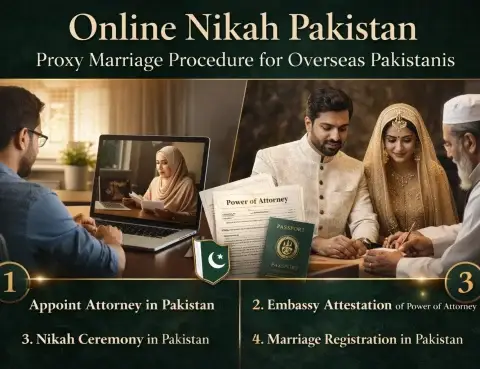
Online Marriage in Pakistan 2026 – Is It Legally Valid?
Introduction
With the increasing number of overseas Pakistanis living in Europe, the United Kingdom, the United States, the Middle East, and other countries, many couples are asking whether they can perform an Online Nikah in Pakistan while they remain abroad.
In recent years, online marriages and proxy marriages have become a practical solution for couples who cannot travel due to visa restrictions, employment commitments, or study abroad. However, many people are uncertain about the legal validity of online marriage in Pakistan, whether such marriages are recognized by government authorities, and whether they are accepted internationally.
This article explains the legal framework of Online marriage in Pakistan, the proxy marriage procedure, MOFA attestation issues, international recognition, and the correct legal procedure for conducting such marriages in 2026.
Legal Status of Online Marriage in Pakistan
Under Islamic law and Pakistani family law, marriage (Nikah) is a civil contract that can be concluded through offer and acceptance in the presence of witnesses. Traditionally, both parties are present at the Nikah ceremony. However, Islamic jurisprudence also allows Nikah through representatives (attorneys).
This means that if one party cannot physically attend the ceremony, they may appoint an attorney (Wakeel) to represent them during the Nikah ceremony.
Therefore, what is commonly referred to as Online marriage in Pakistan is usually a proxy marriage, where one or both parties appoint representatives to conclude the marriage contract.
Pakistani law does not expressly prohibit proxy marriages, and Nikah can legally take place through authorized representatives, provided that the following conditions are fulfilled:
-
Consent of both parties must be clear and voluntary.
-
At least two Muslim witnesses must be present.
-
The Nikah Khawan (marriage registrar) must conduct the ceremony.
-
The marriage must be registered in the Union Council through a Nikah Nama.
However, the issue becomes complicated when one or both spouses are abroad, because documentation and recognition requirements vary depending on the country involved.
What is Online Nikah or Proxy Marriage?
Online marriage in Pakistan refers to a marriage where one or both spouses participate remotely, usually through video conferencing, while a representative performs the marriage ceremony on their behalf in Pakistan.
In legal terms, this is not purely an “online marriage” but rather a proxy marriage, where a representative acts as the authorized attorney of the absent spouse.
For example:
-
The bride may be in Austria, UK, or the USA.
-
She appoints an attorney in Pakistan through a Special Power of Attorney.
-
The attorney represents her during the Nikah ceremony conducted in Pakistan.
After the ceremony, the marriage is registered through the Nikah Registrar and Union Council.
Procedure for Online Marriage in Pakistan (Step-by-Step)
The following is the proper legal procedure for conducting an online or proxy marriage in Pakistan.
Step 1 – Appointment of Attorney (Wakeel)
The spouse who is outside Pakistan must execute a Special Power of Attorney authorizing a representative in Pakistan to conduct the Nikah on their behalf.
The Power of Attorney must include:
-
Full name of the bride and groom
-
CNIC / passport details
-
Authority to perform Nikah
-
Consent for marriage
-
Details of Mehr (dower)
This document must be signed by the overseas spouse.
Step 2 – Attestation from Pakistani Embassy
The Power of Attorney must be attested by the Pakistani Embassy or Consulate in the country where the overseas spouse resides.
Embassy attestation confirms:
-
The identity of the person signing the document
-
Authenticity of the Power of Attorney
-
Validity of authorization
This step is extremely important because unattested documents may create legal complications later.
Step 3 – Sending Documents to Pakistan
Once attested, the documents are sent to Pakistan through a courier service such as:
-
DHL
-
FedEx
-
UPS
The original Power of Attorney must reach Pakistan before the Nikah ceremony.
Step 4 – Conducting the Nikah Ceremony
After receiving the documents, the Nikah ceremony is conducted in Pakistan.
The ceremony includes:
-
Presence of Nikah Khawan (licensed marriage registrar)
-
Presence of two witnesses
-
Attorney representing the overseas spouse
-
Recitation of Khutba-e-Nikah
In many cases, the overseas spouse may join the ceremony through video call, although the legal validity is based on the Power of Attorney, not the video presence.
Step 5 – Registration of Marriage
After the Nikah ceremony, the marriage is registered through the official Nikah Nama issued by the Nikah Registrar.
The Nikah Nama is then submitted to the Union Council for official registration.
Once registered, the couple receives a certified marriage certificate.
MOFA Attestation Issues for Online Marriage
One of the most important issues regarding Online marriage in Pakistan is attestation by the Ministry of Foreign Affairs (MOFA).
In recent years, MOFA Pakistan has become increasingly cautious in attesting proxy marriages, especially where both spouses were not physically present.
In many cases:
-
MOFA may refuse attestation of marriages conducted purely online.
-
Additional verification may be required.
-
Authorities may demand proof of physical presence or proper legal documentation.
Therefore, the documentation must be prepared carefully to avoid complications.
Recognition of Online Marriage Abroad
Another critical issue is whether online marriages performed in Pakistan are recognized abroad.
Many Western countries, including:
-
United Kingdom
-
United States
-
Several European countries
have strict rules regarding proxy marriages.
In many cases:
-
Proxy marriages are not recognized for immigration purposes unless the marriage has been consummated after the ceremony.
-
Some countries require both spouses to be physically present during the marriage ceremony.
Therefore, couples planning immigration applications must carefully consider the recognition laws of the destination country.
Advantages of Online Marriage in Pakistan
Despite the legal complexities, online marriages may offer several advantages:
Convenience for Overseas Pakistanis
Couples living abroad can perform marriage without traveling immediately to Pakistan.
Faster Process
Marriage documents can be completed quickly once the Power of Attorney is prepared.
Cost Savings
Travel expenses and visa issues can be avoided.
Disadvantages and Legal Risks
There are also certain risks associated with online marriages.
International Recognition Problems
Many countries do not recognize proxy marriages for immigration or spouse visa purposes.
MOFA Attestation Difficulties
Attestation may be refused if documentation is not properly prepared.
Future Legal Disputes
Improperly executed proxy marriages may create complications in court proceedings.
Safer Alternatives for Overseas Couples
To avoid legal complications, many legal experts recommend the following options:
Marriage in the Country of Residence
Couples may marry according to the laws of the country where they live and later register the marriage in Pakistan.
Marriage in Pakistan with Physical Presence
The foreign spouse may travel to Pakistan so the marriage is conducted in the physical presence of both parties.
This method avoids many of the recognition issues associated with proxy marriages.
Conclusion
Online Nikah or proxy marriage in Pakistan is legally possible under Islamic law and Pakistani family law, provided that the proper legal procedure is followed.
However, couples should be aware that MOFA attestation and international recognition issues may arise, particularly when the marriage is conducted without the physical presence of both spouses.
Therefore, it is essential to ensure that all legal documentation is properly prepared and attested, especially when one spouse resides abroad.
For overseas Pakistanis planning marriage, obtaining professional legal guidance before conducting an online Nikah can help prevent future legal complications.
Contact Pak-Lawyer Associates
If you require legal assistance regarding Online marriage in Pakistan, Proxy Marriage Pakistan, or Court Marriage Pakistan, you may contact Pak-Lawyer Associates for professional legal guidance. Our legal team regularly assists overseas Pakistanis with marriage documentation, embassy-attested power of attorney, and marriage registration in Pakistan.
📞 Pakistan: +92 321 4610092
📞 UK / International: +44 7417 528692
✉️ Email: ask@paklawyer.com
🌐 www.paklawyer.com
Khula in Pakistan – Complete Legal Procedure, Supreme Court Judgments & Family Court Process (2026 Guide).
Introduction:
Marriage in Islam is regarded as a sacred social contract that creates mutual rights and responsibilities between spouses. However, when marital relations break down and reconciliation becomes impossible, Islamic law and Pakistani family laws provide mechanisms for dissolution of marriage.
One such legal remedy is Khula in Pakistan, which allows a woman to seek dissolution of marriage through the Family Court when continuation of the marital relationship becomes impossible.
In Pakistan, the concept of Khula is primarily governed by:
Over the years, the Superior Courts of Pakistan, including the Supreme Court of Pakistan, have clarified that a woman may obtain Khula even without the consent of the husband if she proves that she cannot live with him within the limits prescribed by Islam.
This comprehensive guide explains:
- What Khula means in Pakistani law
- Legal procedure for filing Khula
- Important Supreme Court judgments
- Family court process and timeline
- Rights of wife and husband after Khula
What is Khula in Pakistan?
Khula is a form of dissolution of marriage initiated by the wife through the court when she is unwilling or unable to continue marital life with her husband.
In Islamic jurisprudence, Khula literally means “to remove” or “to take off,” similar to removing a garment. The concept signifies the termination of marriage at the request of the wife in return for consideration, usually the return of dower (Haq Mehr).
Under Pakistani law, Khula in Pakistan is a judicial process, meaning it must be granted through a decree of the Family Court.
Unlike divorce pronounced by the husband (Talaq), Khula requires:
- Filing a suit before Family Court
- Court reconciliation proceedings
- Judicial decree of dissolution
Understanding the Importance of Khula in Pakistan
The concept of Khula in Pakistan plays a crucial role in protecting the legal and social rights of Muslim women who are facing marital disputes. Under Pakistani family law, Khula in Pakistan allows a wife to approach the Family Court when the marital relationship becomes impossible to continue within the limits prescribed by Islam. Over the years, the courts have clarified the legal framework governing Khula in Pakistan, making it easier for women to seek judicial dissolution of marriage without unnecessary procedural barriers.
Today, the procedure for Khula in Pakistan is well established under family law statutes and judicial precedents. Women who seek Khula in Pakistan may file a suit before the Family Court having jurisdiction over the place of residence or marriage. The Family Court then initiates reconciliation proceedings, and if reconciliation fails, the court may grant a decree of Khula in Pakistan in accordance with Islamic principles and Pakistani law
Legal Basis of Khula in Pakistan
The right of a woman to seek Khula in Pakistan derives from Islamic principles as well as statutory laws.
1. Dissolution of Muslim Marriages Act 1939
The Dissolution of Muslim Marriages Act 1939 provides several grounds on which a woman may seek dissolution of marriage, including:
-
Husband’s disappearance
- Failure to provide maintenance
- Cruelty
- Impotence
- Husband’s imprisonment
However, even without proving these grounds, courts may grant Khula if the wife states she cannot live with the husband within Islamic limits.
2. Family Courts Act 1964
The Family Courts Act 1964 provides procedural rules for family litigation including:
- Khula suits
- Custody of children
- Maintenance claims
- Dower recovery
Family Courts have exclusive jurisdiction to decide Khula cases.
Latest Supreme Court Law on Khula in Pakistan (2024–2026)
Pakistani courts have consistently affirmed the right of a Muslim woman to seek dissolution of marriage through Khula even where the husband refuses consent. The jurisprudence on this subject was firmly established by the superior courts, particularly in Khurshid Bibi v. Muhammad Amin, where the Supreme Court of Pakistan recognized that a woman may obtain a decree of Khula if she satisfies the court that she cannot live with her husband “within the limits prescribed by Islam.” This principle has been repeatedly reaffirmed in later precedents such as PLD 2006 SC 613 and PLD 2014 SC 330, which clarified that the wife’s aversion to the marital relationship, coupled with failure of reconciliation efforts, may justify judicial dissolution of marriage.
More recently, the Supreme Court of Pakistan has further strengthened the autonomy and dignity of women in matrimonial disputes. In a 2025 judgment delivered by a bench comprising Justice Ayesha A. Malik and Justice Naeem Akhtar Afghan, the Court reaffirmed that Khula in Pakistan is an independent right of the wife and cannot be made contingent upon the husband’s approval or discretion of the court, emphasizing that family courts should not compel a woman to remain in a marriage where the relationship has irretrievably broken down.
Similarly, in subsequent rulings during 2025–2026, the Supreme Court reiterated that matrimonial disputes must be resolved in a manner that protects the dignity, autonomy, and legal rights of women, and that courts must carefully distinguish between Khula and dissolution of marriage under statutory grounds while ensuring that the wife’s consent and claims are respected.
The consistent judicial approach therefore establishes that where reconciliation fails and the wife states that she cannot continue the marital relationship within Islamic limits, the Family Court may grant a decree of Khula. These decisions collectively reinforce constitutional principles of dignity, equality, and protection of fundamental rights, while aligning Pakistani family law with the equitable spirit of Islamic jurisprudence.
Grounds for Khula in Pakistan
Although Khula can be granted on the wife’s statement alone, courts often consider the circumstances of the marriage.
Common reasons include:
1. Domestic Violence
Physical or psychological abuse often leads to Khula proceedings.
2. Lack of Compatibility
In many cases, spouses develop irreconcilable differences making cohabitation impossible.
3. Neglect or Non-Maintenance
Failure of the husband to maintain his wife can also become a basis for dissolution.
4. Second Marriage of Husband
If the husband contracts another marriage and the wife feels unable to continue the relationship.
5. Forced Marriage
Courts may also consider situations where marriage was arranged without free consent.
Procedure for Khula in Family Court
The legal process for Khula in Pakistan follows a structured procedure under family law.
Step 1: Filing of Suit
The wife files a Suit for Dissolution of Marriage on the Basis of Khula before the Family Court having territorial jurisdiction.
The suit generally contains:
- Details of marriage
- Copy of Nikah Nama
- Grounds for Khula
- Prayer for dissolution
Step 2: Court Notice to Husband
After filing the case, the Family Court issues summons to the husband requiring him to appear before the court.
Step 3: Reconciliation Proceedings
Under Pakistani family law, courts must attempt reconciliation between spouses.
If reconciliation fails, the court proceeds to adjudicate the matter.
Step 4: Statement of Wife
The wife records her statement stating that:
- She cannot live with the husband within Islamic limits
- She is willing to return dower if required
Step 5: Khula Decree
After completing proceedings, the Family Court passes a decree of dissolution of marriage (Khula).
Time Required for Khula in Pakistan
Family Courts aim to decide Khula cases expeditiously.
In practice:
Typical Khula case duration:
- 3 to 6 months in most courts
- Sometimes longer depending on litigation
Recent judicial reforms emphasize speedy disposal of family cases to reduce backlog.
Does Wife Have to Return Haq Mehr?
Traditionally, Khula involves the return of Haq Mehr (dower) by the wife.
However, courts examine circumstances before deciding this issue.
Situations include:
- If husband is at fault
Court may waive the return of dower. - If wife initiates Khula without fault of husband
Court may require return of dower.
Each case depends on judicial discretion.
Khula vs Talaq – Key Differences
| Feature | Khula | Talaq |
|---|---|---|
| Initiated by | Wife | Husband |
| Legal forum | Family Court | Pronounced by husband |
| Court involvement | Required | Not required initially |
| Reconciliation | Mandatory | Recommended |
| Dower return | Possible | Not required |
Understanding this distinction is essential in Pakistani family law.
Effect of Khula on Children
Khula only dissolves the marriage between spouses.
Issues related to children are decided separately under the Guardian and Wards Act 1890.
Courts decide children custody based on the welfare of the minor, not the marital dispute between parents.
Usually:
- Mother receives custody of young children
- Father retains visitation rights
Khula for Overseas Pakistanis
Many Pakistani women living abroad also file Khula cases in Pakistani courts.
Pakistani law allows:
- Filing through Power of Attorney
- Representation through lawyers in Pakistan
This process enables overseas Pakistanis to obtain Khula without personally appearing before the court.
Important Legal Rights After Khula
After the decree of Khula:
- Marriage is dissolved legally.
- Wife observes Iddat period.
- Parties are free to remarry after completion of Iddat.
- Custody and maintenance matters continue under family law.
Common Misconceptions About Khula
Myth 1: Husband consent is required
Not correct. Courts may grant Khula without husband’s consent.
Myth 2: Khula takes many years
Most cases conclude within a few months.
Myth 3: Wife must prove cruelty
Not necessary if she states inability to live with husband within Islamic limits.
Why Legal Assistance is Important
Although Khula appears straightforward, professional legal guidance ensures:
- Proper drafting of suit
- Efficient court proceedings
- Protection of financial and custody rights
Experienced family lawyers help clients navigate the procedural aspects effectively.
Conclusion
Khula is an essential legal remedy available to Muslim women in Pakistan when marital relations become unsustainable.
Pakistani family laws and judicial precedents recognize the right of women to seek dissolution of marriage through the Family Court.
With clear procedural safeguards and evolving judicial interpretation, Khula has become a practical legal mechanism to ensure justice and dignity within the framework of Islamic and Pakistani law.
Individuals facing marital disputes should seek timely legal advice to understand their rights and available remedies.
Frequently Asked Questions (FAQ)
What is Khula in Pakistan?
Khula is a judicial dissolution of marriage initiated by the wife through the Family Court when she cannot continue marital life with her husband.
Is husband consent required for Khula?
No. Pakistani courts may grant Khula even without the consent of the husband if the wife declares she cannot live with him within Islamic limits.
How long does Khula take in Pakistan?
Most Khula cases are decided within two to three months depending on court workload.
Does the wife have to return Haq Mehr?
In many cases courts require return of dower, but this depends on circumstances and judicial discretion.
Can overseas Pakistanis obtain Khula?
Yes. Overseas Pakistani women may file Khula suits through Power of Attorney in Pakistani courts.
————————————————————————————————————————–
Speak to a Family Lawyer About Khula in Pakistan
If you are facing serious marital difficulties and wish to understand your legal options regarding Khula in Pakistan, dissolution of marriage, child custody, or family court proceedings, it is advisable to seek timely legal advice. The experienced family law team at Pak-Lawyer Associates regularly represents clients in complex family litigation and Khula matters before Family Courts across Pakistan, particularly in Lahore and other major jurisdictions.
We provide confidential legal consultation, case assessment, drafting of Khula suits, and full court representation. Our firm also assists overseas Pakistanis who wish to file Khula cases in Pakistan through Power of Attorney, allowing the legal process to proceed efficiently without the need for frequent travel.
For professional guidance and a free initial consultation, you may contact us using the details below:
📞 Pakistan Office: +92 321 4610092
💬 WhatsApp (International Clients – UK): +44 7417 528692
📧 Email: ask@paklawyer.com
🌐 Website: www.paklawyer.com
Our legal team will carefully review your situation and guide you through the complete Khula procedure in Pakistan, ensuring that your legal rights and interests are fully protected under Pakistani family law.

Child Custody & Visitation Rights in Pakistan (2026): Complete Legal Guide for Parents & Overseas Cases
Child custody disputes are among the most emotional and sensitive family matters. Parents may separate through divorce, khula, judicial separation, or simple breakdown of relations—yet the most painful question remains:
✅ Who will keep the child?
✅ Who will meet the child and when?
✅ Can the child be taken abroad without consent?
This 2026 guide explains Child Custody & Visitation Rights in Pakistan in a practical, legally accurate, and easy way. It covers:
- Father vs mother custody rules according to Pakistan laws
- Hizanat under Islamic law
- Visitation rights / meeting rights
- Child passport and travel permission cases
- Overseas custody disputes involving UAE, UK, USA, Canada, Europe
At Pak-Lawyer Associates (www.paklawyer.com), we regularly handle Child Custody & Visitation Rights in Pakistan, especially in cases involving overseas Pakistanis, travel restrictions, passport blocks, and denied visitation.
Quick Highlights (2026)
- Welfare of the minor is the supreme rule
- Custody is not an “automatic right” of either parent
- Even if custody is with one parent, the other parent usually has visitation rights
- Courts can restrain travel abroad to protect the child and visitation
- Overseas parents can file cases in Pakistan if the child is in Pakistan
What is Child Custody Under Pakistani Law?
In Pakistan, child custody is typically discussed under two legal frameworks:
- Islamic concept of Hizanat (حضانت)
- Guardian and Wards Act, 1890 (court procedure)
Under Child Custody & Visitation Rights in Pakistan, custody generally means:
- daily care
- residence
- schooling decisions
- health and welfare
- moral and emotional upbringing
The case is decided by the Family Court / Guardian Court.
The Golden Principle: Welfare of the Minor
In all custody matters, Pakistani courts repeatedly apply one main principle:
✅ Welfare of the minor is the first and most important consideration.
This means:
- father cannot demand custody only because he is father
- mother cannot demand custody only because she is mother
- custody can be changed if welfare changes
- courts may even grant custody to grandparents if required
This welfare principle is the foundation of Child Custody & Visitation Rights in Pakistan.
Father vs Mother Custody Rules According to Pakistan Laws
This section is written specifically for high-search queries like:
✅ “father vs mother custody rules Pakistan”
✅ “custody of child after divorce in Pakistan”
✅ “who gets custody in Pakistan father or mother”
Understanding Child Custody & Visitation Rights in Pakistan requires clarity on two things:
- physical custody (Hizanat / residence)
- guardianship (long-term legal responsibility)
Who is the Natural Guardian in Pakistan?
Under Pakistani law and Islamic principles, the father is generally considered:
✅ “Natural Guardian” of minor children.
This means father is typically responsible for:
- finances and maintenance
- educational supervision
- property and inheritance matters
- major decisions
However, this does not automatically mean father will get physical custody.
That is why Child Custody & Visitation Rights in Pakistan makes an important distinction between:
✅ Guardianship vs ✅ Hizanat (Custody)
Hizanat (Physical Custody) Usually Goes to Mother (Especially for Young Child)
As a general rule in Child Custody & Visitation Rights in Pakistan:
✅ Mother is preferred for young children.
Because:
- mother provides better emotional care
- minors need maternal affection
- breast-feeding / early child development
- day-to-day stability
Age Factor in Custody (Boy / Girl)
People ask:
❓ “Up to what age mother has custody in Pakistan?”
❓ “At what age father gets custody?”
Traditional principles mention:
- Boy: mother’s custody up to 7 years
- Girl: mother’s custody till puberty
But modern Pakistani courts do not apply age alone. They apply welfare.
So in Child Custody & Visitation Rights in Pakistan, age is relevant but not final.
Hizanat Under Islamic Law (Pakistan)
What is Hizanat?
Hizanat (حضانت) means:
the right of upbringing, protection, and physical custody of a minor child.
In Child Custody & Visitation Rights in Pakistan, Hizanat is central.
Who Has the First Right of Hizanat?
Generally:
✅ mother
✅ maternal grandmother
✅ maternal aunt
✅ paternal grandmother
✅ other female relatives
✅ father (if welfare demands)
But again, welfare comes first.
When Can a Mother Lose Custody in Pakistan?
Mother may lose custody if the court finds:
- neglect or poor care
- moral misconduct affecting welfare
- violence or abuse
- inability to provide safe environment
- strong evidence that child’s wellbeing is harmed
❗ Remarriage Issue
Many believe:
mother automatically loses custody after remarriage
This is NOT absolute.
Pakistani courts check:
- child’s comfort and welfare
- stepfather’s environment
- risk to child
Thus in Child Custody & Visitation Rights in Pakistan, remarriage is a factor—not automatic disqualification.
When Can Father Get Custody in Pakistan?
Father can obtain custody if:
- mother is unfit
- mother is denying visitation repeatedly
- child’s education needs better stability
- mother is living abroad and cannot personally keep child
- child’s welfare and security demands custody with father
So in Child Custody & Visitation Rights in Pakistan, father custody is possible and common in suitable cases.
Child Custody & Visitation Rights in Pakistan After Divorce / Khula
After divorce, custody issues typically arise due to:
- ego conflicts
- financial disputes
- remarriage
- overseas travel
- new family pressures
Family Courts handle these matters through custody petitions.
Which Court Has Jurisdiction?
In Child Custody & Visitation Rights in Pakistan, jurisdiction is based on:
✅ where the minor ordinarily resides
So if child is living in Lahore, case is filed in Lahore Family Court/Guardian Court.
Visitation Rights in Pakistan (Meeting Rights of Parents)
Visitation is a crucial part of Child Custody & Visitation Rights in Pakistan.
Even if custody is awarded to one parent, the other parent usually retains:
✅ meeting rights
✅ weekend visitation
✅ holiday visitation
✅ phone/video call access
What If Custodial Parent Denies Visitation?
This is one of the most common disputes.
Example:
- Mother has custody but denies meetings
- Father has custody but blocks child from mother
✅ Legal Remedy:
The aggrieved parent can file:
- Visitation petition
- Enforcement application
- Application for contempt / strict action (in extreme cases)
Courts can:
- fix schedule
- allow court-based meetings
- impose penalties
- direct police assistance
Thus Child Custody & Visitation Rights in Pakistan also protects the non-custodial parent.
Typical Visitation Schedule Set by Courts
Common court schedules include:
- once per week (Sunday)
- 2 to 4 hours meeting
- meetings at court premises
- Eid day meeting
- school holidays / summer vacations
In overseas cases, courts may allow:
✅ video calls (WhatsApp / Zoom)
✅ monthly extended visitation
Supervised Visitation
Court may order supervised visitation when:
- child is very young
- serious allegations exist
- kidnapping risk exists
- parent has history of violence
This is a very important safety tool under Child Custody & Visitation Rights in Pakistan.
Child Passport & Travel Permission Cases in Pakistan
Now the most trending topic in custody disputes is:
✅ child passport
✅ minor travel permission
✅ overseas relocation
This part is extremely important for Child Custody & Visitation Rights in Pakistan, especially for:
- UK / Canada immigration
- UAE residence visas
- study visas and family settlement
Can Mother Take Child Abroad Without Father’s Permission?
In Pakistan, if father is guardian or there is no court permission:
✅ Mother generally needs:
- father’s consent OR
- court order
If father refuses, mother may file:
✅ petition for permission to apply passport and travel abroad
Can Father Stop Child Passport?
Yes. Father can approach court if:
- he fears child will be permanently taken abroad
- visitation will be destroyed
- mother may not return child
Court can pass:
- injunction / restraint order
- directions to passport authorities
- stay against travel
This is a major part of Child Custody & Visitation Rights in Pakistan today.
What Does Court Consider in Travel Permission?
The Guardian Court considers:
- welfare of the child
- purpose of travel (study / medical / visit)
- duration of travel
- mother’s bona fide intention
- father’s visitation rights
- return guarantee (bond / surety)
Courts can also order:
✅ Undertaking (affidavit)
✅ Surety bond
✅ Return ticket submission
Documents for Child Travel Permission Case
To strengthen your case under Child Custody & Visitation Rights in Pakistan, attach:
- child B-Form / CRC
- passport copy (if exists)
- custody order / divorce documents
- visa documents
- flight booking
- school admission letters
- medical letters (if treatment)
- affidavits and undertakings
Child Custody & Visitation Rights in Pakistan for Overseas Pakistanis
This is a high search volume area.
Overseas Pakistanis frequently face issues like:
- one parent brings child from UK/UAE to Pakistan
- child is not returned
- foreign court orders exist
- visitation is blocked due to distance
Can Overseas Parent File Custody Case in Pakistan?
✅ Yes.
If minor is in Pakistan, Pakistani courts can take jurisdiction.
Overseas parent can file:
- custody petition
- visitation petition
- child recovery petition
- travel restraint application
This is a key part of Child Custody & Visitation Rights in Pakistan.
International Custody Conflict: Foreign Orders vs Pakistan Courts
Many overseas parents have:
- UK court orders
- UAE family settlement decisions
- Canada custody orders
- Haque Convention Authority
Pakistani courts may consider foreign documents but still apply:
✅ welfare
✅ jurisdiction
✅ Pakistani law principles
Therefore, overseas custody litigation requires an experienced lawyer.
Step-by-Step: How to File Custody Case in Pakistan
Here is the practical process for Child Custody & Visitation Rights in Pakistan:
Step 1: Draft custody petition
Based on welfare and facts.
Step 2: Attach evidence
B-form, divorce decree, school letters etc.
Step 3: Court issues notice
Respondent is summoned.
Step 4: Interim visitation order
Court often provides immediate visitation.
Step 5: Evidence stage
Witnesses, documents, welfare inquiry.
Step 6: Final custody order
Custody and visitation schedule.
Can Custody Order Be Changed Later?
✅ Yes.
Custody is always adjustable because welfare may change.
If circumstances change, file:
- modification petition
- restoration of custody
- appeal/revision
This is a core concept of Child Custody & Visitation Rights in Pakistan.
Practical Tips for Strong Custody Case
To win custody or visitation, focus on:
✅ child’s schooling plan
✅ stable home environment
✅ proper medical support
✅ moral and safe environment
✅ relationship with both parents
✅ evidence of denial of visitation
✅ willingness for joint parenting
Courts appreciate:
Courts Appreciate Calm Conduct
Family Courts prefer parents who remain respectful and controlled. Calm conduct shows maturity, stability, and a safe environment for the child.
Courts Appreciate Child-Centered Arguments
Judges focus on the child’s welfare, not the parents’ ego. Strong cases discuss the child’s education, health, routine, emotional needs, and future stability.
Courts Appreciate Cooperation in Visitation
Allowing visitation proves that you are responsible and not using the child as a weapon. Courts favor parents who facilitate meetings, calls, and a healthy relationship with the other parent.
Common Mistakes in Custody & Visitation Disputes
Avoid these mistakes:
❌ using child to hurt other parent
❌ blocking visitation out of ego
❌ taking child abroad secretly
❌ violating court orders
❌ coaching child to hate other parent
❌ making false allegations without proof
These mistakes can damage your case under Child Custody & Visitation Rights in Pakistan.
Why You Should Hire a Competent Custody Lawyer
Custody litigation is technical and sensitive.
A skilled lawyer can:
- secure early interim custody/visitation
- obtain urgent travel restraint orders
- draft correct pleadings
- present welfare-based evidence
- enforce court orders effectively
At Pak-Lawyer Associates, we handle Child Custody & Visitation Rights in Pakistan with complete confidentiality and professional care.
Conclusion: Child Custody & Visitation Rights in Pakistan
To summarize, Child Custody & Visitation Rights in Pakistan are decided based on:
✅ welfare of the minor
✅ emotional and physical wellbeing
✅ stable upbringing and education
✅ lawful visitation schedule
✅ protection from illegal relocation abroad
If you are facing any custody, visitation, passport or overseas dispute, always seek proper legal help to avoid technical mistakes.
Contact Pak-Lawyer Associates (Custody & Overseas Cases)
For professional legal assistance regarding Child Custody & Visitation Rights in Pakistan, contact:
🌐 www.paklawyer.com
📍 Lahore, Pakistan
✅ Experienced Family Lawyers
✅ Overseas Pakistanis Cases
✅ Custody + Visitation + Travel Permission
FAQs (Rank Math FAQ Schema – Copy-Paste)
✅ What is Child Custody & Visitation Rights in Pakistan?
Child Custody & Visitation Rights in Pakistan refers to the legal rules governing who keeps a minor child after separation and how the other parent can meet or communicate with the child.
✅ Who gets custody after divorce in Pakistan?
In most cases, mother is preferred for young minors under Hizanat principles, but the court decides according to the welfare of the child.
✅ Can father get custody of child in Pakistan?
Yes, father can get custody if mother is unfit or if child’s welfare requires custody with father.
✅ What is Hizanat under Islamic law?
Hizanat means physical custody and upbringing of a minor child, usually granted first to the mother, subject to welfare.
✅ Can mother travel abroad with child without father’s consent?
Usually, mother requires father’s consent or a court order. Guardian Court can grant travel permission depending on welfare.
✅ What can I do if my ex-spouse denies visitation?
You can file a visitation and enforcement petition to secure meeting rights under Child Custody & Visitation Rights in Pakistan.

Online Divorce & NADRA Record Update in Pakistan (2026 Complete Guide)
Divorce is not only an emotional decision — it is also a strict legal and documentary process in Pakistan. Many people assume that once talaq is pronounced or khula is granted by court, the divorce automatically ends in government records.
However, in practice, divorce is considered properly completed only when:
- It is registered at the concerned Union Council, and
- The person’s NADRA marital status is updated (CNIC + family tree record)
This is why the topic Online Divorce & NADRA Record Update in Pakistan has become one of the most searched legal queries in 2026, especially for overseas Pakistanis.
What is Online Divorce in Pakistan?
The term Online Divorce & NADRA Record Update in Pakistan does not mean Pakistan issues a divorce certificate via a website.
Instead, it means the divorce process can be managed remotely through a lawyer, including:
- Online consultation
- Online documentation and drafting
- Remote filing and follow-ups
- Representation before Family Court and Union Council
- Divorce certificate collection
- NADRA record update assistance
✅ Online divorce is possible, but legal steps must still be completed inside Pakistan.
Why Online Divorce & NADRA Record Update in Pakistan is Trending in 2026
The demand for Online Divorce & NADRA Record Update in Pakistan is increasing due to:
- Overseas Pakistanis (UK / USA / Canada / UAE / EU)
- Spouses living in different cities or countries
- Confidential and safe legal handling
- Immigration and visa requirements
- Remarriage legality
- NADRA record mismatches and disputes
Types of Divorce Recognized in Pakistan
Before starting Online Divorce & NADRA Record Update in Pakistan, it is important to understand the two main legal types:
1) Talaq (Divorce by Husband)
This includes:
- Pronouncement of talaq
- Written notice to Union Council
- Completion of 90 days reconciliation period
- Issuance of Union Council divorce certificate
2) Khula (Divorce by Wife through Family Court)
This includes:
- Filing khula suit in Family Court
- Court decree of khula
- Submission of decree to Union Council
- Completion of 90 days process in Union Council
- Union Council certificate
- NADRA marital status update
Important Rule: Divorce Must Be Registered
A major misconception is:
“Talaq is done, divorce is complete.”
✅ In Pakistan, divorce becomes officially effective only when completed through Union Council proceedings.
This is the foundation of Online Divorce & NADRA Record Update in Pakistan.
PART A — Online Talaq Procedure (Divorce by Husband)
Online Talaq Procedure in Pakistan (Step-by-Step)
The following steps are standard for Online Divorce & NADRA Record Update in Pakistan (Talaq case):
Step 1: Draft Talaq Notice in Legal Format
A properly drafted talaq notice should mention:
- Husband name, CNIC / passport number
- Wife name, CNIC (if available)
- Nikah date + Nikahnama details
- Clear statement of divorce
- Date of pronouncement
- Signatures
✅ Always use a lawyer for correct wording to avoid Union Council objections.
Step 2: Submit Talaq Notice to Concerned Union Council
The notice must be submitted to the concerned Union Council.
✅ Very Important Legal Point:
The 90 days reconciliation period starts when the talaq notice is submitted/received by the concerned Union Council.
It does not start from the verbal pronouncement.
Example:
- Talaq pronounced on 1 January
- Notice submitted to Union Council on 20 January
➡️ The 90 days begin from 20 January
This point must be clearly understood in Online Divorce & NADRA Record Update in Pakistan.
Step 3: Union Council Issues Notices & Reconciliation Starts
After receiving notice, Union Council typically:
- Sends notice to both spouses
- Forms reconciliation council
- Schedules hearing/meetings
Step 4: Divorce Certificate After Completion of 90 Days
If reconciliation fails:
- Divorce becomes effective after 90 days
- Union Council issues Divorce Registration / Effectiveness Certificate
✅ This certificate is essential for NADRA updates.
PART B — Online Khula Procedure (Divorce by Wife)
What is Online Khula in Pakistan?
Khula is the legal right of wife to seek dissolution of marriage from Family Court.
In most cases, wife states:
- “I cannot live with my husband within the limits prescribed by Islam.”
This procedure is also part of Online Divorce & NADRA Record Update in Pakistan.
Online Khula Procedure (2026 Step-by-Step)
Step 1: Draft Khula Petition
A khula petition generally includes:
- Nikah details
- Dower / Haq Mehr details
- Reasons for khula (cruelty, non-maintenance, incompatibility etc.)
- Child custody information (if any)
Read more: Divorce Procedure in Pakistan
Step 2: Filing in Family Court
Khula suit is filed in Family Court having jurisdiction where:
- Wife resides, OR
- The spouses last lived together (depending on facts)
Step 3: Court Issues Summons to Husband
Court sends notices/summons.
If husband does not appear:
- Case may proceed ex-parte (one sided)
Step 4: Statement of Wife and Evidence
Wife records statement.
If wife is overseas, it can be done via:
- Affidavit
- Attorney
- In some cases, video call (depending on court)
Step 5: Khula Decree Issued
Court grants khula decree.
📌 Important: Khula decree alone is not enough for NADRA update.
Union Council Stage After Khula Decree
After decree:
- Decree must be submitted before Union Council
✅ Very Important Legal Point:
The 90 days period starts when the divorce decree is submitted/received by the concerned Union Council.
This is the key legal requirement of Online Divorce & NADRA Record Update in Pakistan.
PART C — Divorce Registration at Union Council
Why Union Council Registration is Mandatory
Union Council registration is required because:
- It completes legal divorce process
- It generates official divorce certificate
- It allows NADRA record correction
- It protects both parties legally
This is why Union Council is always included in Online Divorce & NADRA Record Update in Pakistan.
Documents Required for Divorce Registration
Commonly required documents:
- Husband CNIC copy
- Wife CNIC copy
- Nikahnama copy
- Talaq notice OR khula decree
- Application / cover letter
- Passport copies (if overseas)
PART D — NADRA Marital Status Update After Divorce
What is NADRA Marital Status Update?
It means updating official record:
- CNIC marital status to Divorced
- Removing spouse linkage in family tree
- Correcting Family Registration Certificate (FRC)
✅ This is the most important practical outcome of Online Divorce & NADRA Record Update in Pakistan.
Why NADRA Update is Important
If NADRA record is not updated:
- CNIC still shows “Married”
- Remarriage becomes problematic
- Visa/immigration complications occur
- Family tree remains incorrect
- Legal disputes may arise later
Documents Required by NADRA
NADRA typically requires:
- Union Council divorce certificate (most important)
- Khula decree (if applicable)
- CNIC original
- Application for record modification
📌 Without Union Council certificate, NADRA may refuse update.
Step-by-Step NADRA Update Process
Follow these steps for Online Divorce & NADRA Record Update in Pakistan:
- Obtain Union Council divorce certificate
- Visit NADRA Registration Center (prefer executive center)
- Apply for marital status modification
- Complete biometric verification
- CNIC record updated to Divorced
- Family tree corrected
PART E — Overseas Pakistanis: Power of Attorney Requirements
Power of Attorney is Required for Overseas Online Divorce
Overseas clients commonly complete Online Divorce & NADRA Record Update in Pakistan using a Special Power of Attorney.
Power of Attorney Must Contain Clear Divorce Instructions
Power of Attorney must clearly authorize:
- Submission of talaq notice to Union Council
- Filing khula / divorce proceedings
- Appearing before Family Court and Union Council
- Receiving divorce certificate
- Applying for NADRA marital status update
✅ Without clear divorce instructions, legal technical objections may arise.
Power of Attorney Must Be Attested Properly (MOFA Important)
For safe and legal validity:
✅ Power of Attorney should be attested:
- From Pakistani Embassy/Consulate abroad
- Then attested from MOFA Pakistan
This avoids technical issues in Union Council and NADRA process.
Common Mistakes to Avoid
In Online Divorce & NADRA Record Update in Pakistan, the common mistakes are:
- Not submitting notice/decree to Union Council
- Confusion about 90 days period
- Not obtaining Union Council divorce certificate
- Ignoring NADRA update
- Using weak or unclear power of attorney
Why You Must Engage a Competent Lawyer
Divorce matters involve sensitive rights and technical legal steps. A competent lawyer ensures:
- Correct drafting (talaq notice / khula petition)
- Proper Union Council submission
- Correct calculation of 90 days period
- Divorce certificate issuance
- NADRA record update without rejection
✅ For Online Divorce & NADRA Record Update in Pakistan, professional legal handling prevents future litigation and technical objections.
Frequently Asked Questions (FAQs)
Is online divorce valid in Pakistan?
Yes, online divorce is valid if legal steps are completed through Union Council and NADRA update.
When does the 90 days period start?
The 90 days start when divorce notice or khula decree is submitted/received by the concerned Union Council.
Can NADRA update marital status without Union Council certificate?
Usually no. NADRA requires Union Council certificate.
Do overseas Pakistanis need MOFA attestation on power of attorney?
Yes, it is highly recommended and often essential to avoid technical objections.
Conclusion
The process of Online Divorce & NADRA Record Update in Pakistan is very helpful in modern times, especially for overseas Pakistanis. However, online handling does not mean skipping legal procedure.
To complete divorce safely, always ensure:
- Submission of notice/decree to Union Council
- 90 days period completion starts from Union Council submission date
- Union Council divorce certificate obtained
- NADRA marital status updated
- Competent lawyer engaged
Need Legal Help? (Pak-Lawyer Associates)
For complete assistance in:
✅ Online Divorce & NADRA Record Update in Pakistan
✅ Online talaq notice drafting and Union Council filing
✅ Online khula (Family Court)
✅ Union Council divorce certificate
✅ NADRA marital status update / family tree correction
✅ Overseas Pakistanis Power of Attorney guidance (MOFA attestation)

7 Legal serious Consequences of Second Marriage Without Permission in Pakistan (2026)
Second Marriage Without Permission in Pakistan occupies a sensitive and often misunderstood position within Pakistani society. While Islamic jurisprudence permits a Muslim man, subject to strict moral conditions, to contract more than one marriage, Pakistani statutory law regulates and restricts second marriage through mandatory legal procedures. The purpose of such regulation is not to negate religious principles but to protect the dignity, legal rights, and emotional security of the first wife and to prevent abuse of religious permissibility.
A widespread misconception persists that religious permission alone is sufficient to validate a second marriage. This assumption is legally incorrect. Under Pakistani law, contracting a second marriage without fulfilling statutory requirements constitutes a criminal offence, regardless of whether a Nikah ceremony has been solemnized.
This article provides a comprehensive 2026 legal analysis of second marriage in Pakistan, and consequences of Second Marriage Without Permission in Pakistan including the statutory framework, procedural requirements, criminal and civil consequences, authoritative judicial pronouncements, rights of the aggrieved wife, status of the second wife and children, remedies available before courts, and emerging legal trends.
Is Second Marriage Legal in Pakistan?
Yes, second marriage is legally permissible in Pakistan, but only when the conditions prescribed by law are strictly fulfilled.
Islamic law allows plural marriages subject to the condition of justice and equality. However, the Pakistani legal system, exercising its constitutional and legislative authority, has imposed procedural safeguards to ensure that this permissibility is not misused to inflict injustice, cruelty, or emotional harm upon the existing wife.
It must be clearly understood that:
Religious permissibility does not override statutory law in Pakistan.
A second marriage contracted in violation of statutory requirements is illegal in the eyes of Pakistani law, even if a Nikah has been performed and witnesses are present.
Legal Framework Governing Second Marriage in Pakistan
The legality of second marriage is primarily governed by the following laws:
- Muslim Family Laws Ordinance, 1961
- West Pakistan Family Courts Act, 1964
- Judicial precedents of the Supreme Court of Pakistan and High Courts
These laws collectively regulate marital conduct, family rights, and remedies available to aggrieved spouses in case of Second Marriage Without Permission in Pakistan.
Mandatory Permission Under Muslim Family Laws Ordinance, 1961
Section 6 – The Cornerstone Provision
Section 6 of the Muslim Family Laws Ordinance, 1961 unequivocally mandates that:
A man shall not contract another marriage during the subsistence of an existing marriage except with the prior written permission of the Arbitration Council.
This provision is mandatory in nature, not advisory.
From Whom Is Permission Required?
Permission must be obtained from both:
- The Arbitration Council, constituted under the Ordinance
- The existing wife or wives
Failure to secure permission from either authority renders the second marriage unlawful.
Legal Procedure for Obtaining Permission
The lawful procedure includes the following steps:
- Application to Chairman Union Council
The husband must submit a written application explaining the reasons for intending a second marriage. - Disclosure of Justification
Grounds such as infertility, chronic illness, or other legally acceptable reasons must be disclosed. Mere personal desire is insufficient. - Notice to Existing Wife
The Arbitration Council issues notice to the first wife and records her consent or objection. - Arbitration Council Proceedings
The Council evaluates whether the proposed marriage is just, necessary, and free from malafide intent. - Written Permission
Only upon satisfaction does the Arbitration Council grant written permission.
⚠ In the absence of this written permission, the second marriage is illegal, irrespective of religious rites.
Misconceptions Surrounding Second Marriage
The following misconceptions frequently lead to criminal liability:
- ❌ Islam allows it, therefore law is irrelevant
- ❌ Nikah alone legalizes the marriage
- ❌ Consent of first wife is optional
✔ Judicial Reality: Pakistani courts consistently hold that statutory compliance is compulsory, and religious permissibility does not provide immunity from legal consequences.
Criminal Consequences of Second Marriage Without Permission
A husband who contracts a second marriage without lawful permission exposes himself to criminal prosecution.
Penal Consequences Include:
- Imprisonment up to one year
- Monetary fine
- Immediate payment of entire dower (Haq Mehr) to the first wife, irrespective of deferred terms
Criminal liability arises automatically upon proof of violation of Section 6.
Civil Consequences Under Family Law
In addition to criminal punishment, civil liabilities arise, including:
- Grounds for dissolution of marriage
- Claim for past and future maintenance
- Impact on custody and guardianship determinations
Importantly, civil relief is independent of criminal proceedings and may be pursued simultaneously i case of Second Marriage Without Permission in Pakistan.
Second Marriage as Mental Cruelty – Judicial Interpretation
Pakistani courts have consistently interpreted unauthorized second marriage as mental cruelty inflicted upon the first wife.
The superior judiciary has held that:
A second marriage contracted without permission causes humiliation, emotional trauma, insecurity, and psychological harm to the existing wife, amounting to cruelty.
Legal Effect of Cruelty Finding
Once cruelty is established:
- The wife may seek dissolution of marriage
- No further proof of maltreatment is required
- Divorce is granted as a legal right, not as discretionary Khula
This jurisprudence marks a decisive shift toward protection of women’s dignity.
Rights of the First Wife Under Pakistani Law
The first wife enjoys robust legal protection and may lawfully claim:
Statutory Rights Include:
- ✅ Dissolution of marriage on grounds of cruelty
- ✅ Recovery of unpaid dower
- ✅ Maintenance (past, present, and future)
- ✅ Custody of minor children
- ✅ Compensation or damages, where appropriate
⚖ Critical Legal Distinction:
Divorce granted due to unauthorized second marriage is not Khula; it is dissolution arising from husband’s unlawful conduct.
Criminal Remedies Available to the First Wife
The aggrieved wife may:
- File a criminal complaint under Section 6 MFLO
- Seek prosecution through Magistrate or competent court
- Initiate proceedings through Union Council mechanisms
Criminal law operates independently of family court jurisdiction.
Legal Status of the Second Wife
The status of the second wife requires careful legal understanding.
Legal Position:
- The Nikah is not void ab initio
- The marriage is irregular due to statutory illegality
- The husband remains criminally liable
Rights of Second Wife:
- ✔ Right to maintenance
- ✔ Right to dower
- ✔ Right to legal recognition as spouse
However, these rights do not absolve the husband of criminal responsibility.
Legal Status of Children From Second Marriage
Pakistani law fully safeguards children born from a second marriage.
Children are:
- Legitimate
- Entitled to inheritance
- Entitled to maintenance
- Protected under constitutional guarantees
❗ No child may be penalized for the unlawful acts of parents.
Defences Commonly Raised by Husbands
Courts routinely reject defenses such as:
- Financial capability
- Social pressure
- Personal desire
- Religious justification alone
✔ Only prior written permission constitutes a valid legal defense.
Legal Remedies Available to the Aggrieved Wife
1. Family Court Proceedings
-
She may legally claim:
✅ Divorce on grounds of cruelty
✅ Recovery of unpaid dower
✅ Maintenance (past & future)
✅ Custody of minor children
✅ Compensation in appropriate cases
⚖ Important: Divorce due to second marriage is NOT Khula — it is dissolution based on husband’s misconduct.
2. Criminal Proceedings
- Punishment under MFLO
3. Legal Notice
- Demand for rights and settlement
4. Declaratory or Injunctive Relief
- In complex or cross-jurisdiction cases
Second Marriage and Overseas Pakistanis
A dangerous misconception exists among overseas Pakistanis that Pakistani law does not apply to them.
This belief is legally incorrect.
If:
- The Nikah is registered in Pakistan
- The first wife resides in Pakistan
- Pakistani authorities recognize the marriage
👉 Pakistani courts retain full jurisdiction, regardless of the husband’s foreign residence.
Emerging Legal Trends (2025–2026)
Recent years show a significant rise in:
- Divorce petitions based on second marriage
- Criminal complaints under Section 6
- Maintenance enforcement actions
📌 Courts now adopt a zero-tolerance approach toward unauthorized second marriages.
Role of Pak-Lawyer Associates
Pak-Lawyer Associates provides discreet, professional, and result-oriented legal services in:
- Divorce and dissolution cases
- Second marriage litigation
- Maintenance and custody disputes
- Criminal prosecution under MFLO
- Overseas Pakistani family matters
Frequently Asked Questions (FAQ)
Q1: Is second marriage without permission a crime in Pakistan?
Yes. It is a punishable offence under the Muslim Family Laws Ordinance, 1961.
Q2: Can a wife seek divorce if her husband remarries without permission?
Yes. Courts recognize it as cruelty.
Q3: Are children from second marriage legitimate?
Yes. They enjoy full legal protection.
Q4: Can permission be obtained after marriage?
No. Permission must be obtained before contracting marriage.
Q5: Does Islamic law override Pakistani statutory law?
No. Pakistani courts enforce statutory law.

Basant Lahore 2026 Revival: Legal Implications of Safety SOPs, Liability for Accidents, and Judicial Oversight
Introduction
This guide explains Basant Lahore 2026 Revival legal implications including SOP enforcement, permits, accident liability, and judicial monitoring. The potential revival of Basant Lahore 2026, reportedly backed at the policy level by CM Punjab Maryam Nawaz Sharif, has re-ignited the debate between cultural celebration and constitutional governance. While Basant has historically remained an emblem of Lahore’s cultural identity, its revival is no longer a social issue alone—it is a legal and regulatory test for the State.
Understanding Basant Lahore 2026 Revival legal implications is essential for citizens, vendors, and authorities to avoid legal exposure.
The Basant Lahore 2026 Revival legal implications also extend to cyber monitoring, jurisdiction, and constitutional compliance
Pakistan’s experience with Basant has a documented history of fatalities and public injuries, primarily caused by illegal metallic / glass-coated kite strings (manjha/dor), rooftop falls, electrocutions, and traffic accidents. Consequently, any official Basant revival must withstand scrutiny under:
- Right to life and dignity (Constitution Article 9 & 14)
- Equality and non-discrimination (Article 25)
- Freedom of movement and trade (Articles 15 & 18)
- Reasonable restrictions for public order and safety
- Judicial oversight and precedents involving Basant bans
The revival proposal is presently linked with strict SOPs including: cotton-string kites only, restrictions on motorbikes, drone monitoring, high enforcement, and free transport facilitation. However, SOPs alone are insufficient. The decisive question remains:
Can Basant be revived in Lahore in 2026 in a legally enforceable manner—without exposing the State, organisers, and individuals to criminal, civil, and constitutional litigation?
1. Legal Status of Basant: “Permission” Creates State Responsibility
A fundamental legal point often overlooked is:
Once the Government permits Basant, it assumes a duty of care.
If Basant is revived through notifications, permissions, permits, or facilitation measures, the State becomes responsible to ensure that safety is not merely promised but implemented effectively.
Failure in enforcement may amount to:
- administrative negligence
- breach of public duty
- arbitrary governance (Article 4: right to be treated in accordance with law)
- potential constitutional petitions under Article 199 (Lahore High Court)
Therefore, Basant cannot lawfully operate as a “festival atmosphere with SOPs”; rather it must operate as a regulated public event with enforceable law.
2. SOPs and Enforcement: The Legal Test Is “Implementation”
(A) Cotton-string kites only — Legal enforceability and practical proof
The SOP “cotton dor only” appears attractive; yet legally it raises enforcement questions:
- What is the legal definition of “cotton dor”?
- What qualifies as “coated dor”?
- Which government department has the authority to test and certify?
- Will law enforcement have statutory powers of search, seizure, and arrest?
Without clear mechanisms, enforcement may become arbitrary and prone to abuse, inviting:
- writ petitions against discriminatory raids
- claims of selective enforcement
- allegations of harassment against citizens
Therefore, if Basant is revived, the Government must issue:
✅ notified SOPs + statutory definitions
✅ testing mechanism + seizure protocol
✅ departmental responsibility matrix (police, local government, district administration)
(B) Motorbike bans in Basant zones: legality under proportionality
A motorbike ban is a restriction on movement (Article 15) and may affect equality concerns because motorcycles are predominantly used by working-class citizens. It can, however, remain constitutional if it satisfies:
- lawful notification
- defined time and location
- rational nexus with safety
- equal application and proportional enforcement
Courts usually uphold traffic restrictions when shown to be a reasonable restriction for public safety. But arbitrary or indefinite restrictions can be struck down.
(C) Drone monitoring: Public safety surveillance vs privacy rights
The use of drones for monitoring can be justified under public safety; however it must satisfy:
- lawful authorization / notifications
- defined purpose
- proportionality
- safeguards against misuse
Under constitutional jurisprudence, privacy is increasingly recognized as part of dignity under Article 14. Therefore, large-scale drone surveillance without legal safeguards may trigger constitutional challenges.
3. Civil Liability (Tort Law): Compensation for Death & Injury in Basant Incidents
Pakistan does not have a codified tort statute; however, courts recognize tort principles and compensation through:
- civil suits for damages
- constitutional compensation orders in public law negligence cases
- public interest litigation in mass harm incidents
Legal basis of civil liability:
- Negligence
- Breach of duty of care
- Causation
- Foreseeability
In Basant-related harm, foreseeability is extremely strong because Basant’s risk history is well documented.
Who can be sued?
Potentially:
- kite flyer
- dor seller / manufacturer
- rooftop property owner
- organisers / permit holders
- local administration
- municipal bodies
- police (for negligent enforcement)
Types of damages claimable:
- medical expenses
- rehabilitation costs
- loss of earning
- permanent disability loss
- dependency loss in death cases
- pain and suffering
Conclusion: Basant revival will predictably increase civil litigation unless enforcement becomes strict and documented.
4. Criminal Liability: Negligence, Endangering Life, and Death Cases
In fatal Basant incidents, FIRs often include negligence and reckless conduct offences. Criminal liability may attach where:
- prohibited dor is used/sold
- illegal rooftop gatherings are facilitated
- reckless kite flying causes road accidents
- electrocution or strangulation injuries occur
- motorbike riders fall due to strings across roads
Key legal principle:
If the act is foreseeable and dangerous, negligence becomes criminal when it results in death or serious injury.
Additionally, enforcement failures may result in:
- inquiries against officers
- departmental actions
- negligence cases against authorities
5. Punjab Local Government & Public Duty: Municipal Responsibility
Under local governance frameworks, municipal bodies are bound to regulate:
- vendor licensing
- market monitoring
- public order coordination
- safety enforcement support
If coated dor continues being sold publicly, victims can legally argue:
- breach of public duty
- failure of local governance
- administrative negligence
This increases the legal exposure of:
- city administration
- municipal authorities
- district leadership
6. Constitutionality of Kite String Restrictions: Article 9 Prevails
Any restriction on:
- kite sales
- dor manufacturing
- Basant trade
will be challenged under:
- freedom of trade (Article 18)
- expression/cultural freedom arguments
- equality concerns
However, the State can lawfully defend restrictions through:
Right to life (Article 9) + public safety
Pakistan’s courts have repeatedly prioritized safety over entertainment and profit. The more credible and documented the risk, the stronger the restriction becomes.
Therefore:
✅ banning coated / metallic dor is likely constitutional
✅ even strict regulation is defensible
❌ selective enforcement is vulnerable to constitutional challenge
7. Police Permits & Public Order Powers: Basant Requires Formal Legal Notifications
If Basant is revived, it cannot operate through informal permissions.
Legally necessary steps include:
- public order notifications
- traffic diversion orders
- licensing framework for sellers and events
- rooftop safety regulations
- defined enforcement policy
Otherwise, administrative discretion becomes excessive and challengeable.
8. Cyber Monitoring via PTA / NCCIA: Enforcement vs Free Speech
Modern Basant enforcement inevitably involves monitoring of:
- social media groups
- dor trade pages
- Basant gatherings coordination
- livestreamed rooftop events
Authorities may involve PTA and NCCIA (digital investigations).
However, cyber monitoring must comply with constitutional safeguards:
- legality
- necessity
- proportionality
- due process
Legal risk:
If monitoring becomes excessive, it may be challenged as:
- censorship
- privacy violation
- unlawful surveillance
Thus cyber enforcement must be:
✅ targeted
✅ documented
✅ legally justified
9. Lahore-Specific Issue: North/South District Split and Jurisdiction Confusion
Lahore’s proposed administrative split into North and South districts introduces new risks:
- which authority issues Basant permits?
- which police jurisdiction will enforce SOPs?
- where will FIRs be registered?
- which district administration will coordinate?
If Basant occurs during transition:
- enforcement gaps may occur
- unclear accountability may cause negligence claims
- courts may take judicial notice of administrative failure
This makes governance reform directly relevant to Basant legality.
10. Judicial Oversight: Courts Will Remain Active
Basant is a recurring subject of litigation because of its history of casualties. Courts will likely be approached through:
- public interest petitions
- writs under Article 199
- contempt concerns (if any existing restrictive directions are violated)
- petitions for compensation
Courts typically ask:
- what is the SOP framework?
- how is compliance ensured?
- who is responsible for enforcement?
- what is the safety audit structure?
- what is the emergency response plan?
Conclusion: Basant 2026 Must Be Lawfully Regulated or Not Allowed
Basant revival in Lahore in 2026 is possible only if it is supported by:
- enforceable SOPs notified through law
- strict dor testing and seizure protocol
- vendor licensing and continuous raids
- documented police and district enforcement plan
- emergency response preparedness
- cyber monitoring within constitutional limits
- jurisdiction clarity (especially if Lahore splits)
Without these, Basant will expose:
- citizens to danger
- administration to litigation
- government to constitutional scrutiny
- organisers to criminal and civil liability
In summary: Basant Lahore 2026 Revival: Legal Implications covers strict SOPs, permits, and public safety enforcement in Lahore, Basant may be cultural, but in 2026 Lahore it is ultimately a rule-of-law issue.
FAQ :
What are the Basant Lahore 2026 Revival legal implications for citizens and organizers?
Answer: The Basant Lahore 2026 Revival legal implications include civil and criminal liability for accidents, enforceability of SOPs, permitting under police orders, and possible judicial oversight.
Is Basant legal in Lahore in 2026?
Answer: Basant may be allowed only if Punjab Government issues lawful permissions and enforces strict SOPs. Courts can also intervene if safety measures are inadequate.
Who is responsible if someone dies due to kite string?
Answer: Basant Lahore 2026 Revival: Legal Implications highlights accident liability, compensation claims, and criminal negligence risks. Liability can fall on the kite flyer, illegal dor seller, organisers, and also state authorities if negligence in enforcement is proven.
Can government ban kite strings under the Constitution?
Answer: Yes. Dangerous kite string bans are generally constitutional because right to life and public safety overrides entertainment or trade. Basant Lahore 2026 Revival: Legal Implications discusses police permissions, administrative duties, and judicial oversight
Can the police stop Basant without written order?
Answer: Police typically require lawful orders/notifications for large-scale restrictions. Arbitrary enforcement can be challenged in High Court.
Is drone monitoring legal in Basant enforcement?
Answer: Drone surveillance may be lawful if used proportionately for public safety. Excessive or unlawful monitoring can raise privacy and constitutional concerns. Basant Lahore 2026 Revival: Legal Implications explains the legality of kite-string bans and constitutional concerns
Basant Lahore 2026 Revival: Legal Implications discusses police permissions, administrative duties, and judicial oversight.
Written by
Gull Hassan Khan Advocate High Court
CEO, Pak-Lawyer Associates
🌐 www.paklawyer.com

Taxpayer Difficulties in Pakistan (2026): Key Issues, FBR Challenges, and Practical Solutions
Taxation is supposed to be a structured and predictable system: taxpayers contribute, the state funds public services, and the economy becomes more stable. In Pakistan, however, many individuals, salaried persons, small businesses, and even established companies face persistent difficulties while dealing with the tax system. These difficulties are not just about paying taxes—they include compliance burdens, confusion over rules, digital and procedural issues, notice-and-audit pressure, refund delays, inconsistent enforcement, and uncertainty that discourages documentation and investment.
This article explains the major taxpayer difficulties in Pakistan, why they happen, and what practical steps taxpayers can take to reduce risk, improve compliance, and protect their rights.
1) Complex Tax Laws and Frequent Changes
One of the biggest issues is the complexity of Pakistan’s tax structure among Taxpayer Difficulties in Pakistan. Tax obligations arise under multiple regimes, including income tax, sales tax, federal excise, and provincial taxes. Each category carries its own rules, rates, exemptions, filing procedures, and documentation requirements.
Why this is difficult
- Tax rules change frequently through annual finance acts, SROs, notifications, and amendments.
- Many taxpayers—especially SMEs—lack access to reliable guidance.
- Even professionals face interpretation issues due to ambiguous drafting and overlapping provisions.
Real impact on taxpayers
- Mistakes in returns can trigger notices, penalties, or disallowances.
- Businesses remain unsure about correct classification of income or expenses.
- Compliance becomes expensive due to the need for consultants and legal support.
Result: A system that feels unpredictable and discourages voluntary compliance.
2) Confusing Withholding Tax System (Advance Tax Burden)
Pakistan heavily relies on withholding taxes collected through banks, utilities, mobile services, imports, contracts, rent, property transactions, vehicle registration, and more. For many taxpayers, this becomes a type of “advance tax” deducted at multiple points.
Key difficulties
- Multiple deductions on the same person’s transactions can create an excessive burden.
- Taxpayers often don’t understand whether a deduction is final tax or adjustable tax.
- Some people pay high withholding taxes yet remain technically “non-filers” due to return non-submission.
Common taxpayer complaints
- “My bank deducts tax, my mobile deducts tax, my bills deduct tax—why am I still getting problems?”
- “I paid advance tax but don’t know how to adjust it in the return.”
Result: People feel taxed without clarity, and businesses suffer cash-flow pressure.
3) Return Filing Difficulties and IRIS Portal Challenges
Pakistan’s shift toward digital filing is positive in theory, but many taxpayers struggle with the online process, especially on the FBR IRIS portal.
Problems taxpayers face
- Technical glitches, downtime, or slow portal performance.
- Confusing form fields, annexures, wealth statements, and reconciliation requirements.
- Difficulty in selecting the correct return type (individual/salaried/AOP/company).
- Errors due to “profile mismatch” or missing obligations.
Additional documentation pressure
For many taxpayers, filing isn’t just declaring income—it includes:
- Wealth statement and reconciliation of assets.
- Details of bank accounts, property, vehicles, investments.
- Expense and personal spending disclosures.
Result: Honest taxpayers feel overwhelmed, and many delay filing until deadlines, increasing errors and stress.
4) Lack of Tax Awareness and Guidance for Ordinary Taxpayers
A major structural problem is low tax literacy. Many people do not understand:
- Who must file a return vs. who must pay tax.
- Difference between filer and non-filer status and its consequences.
- How to document income sources properly (salary, business, freelancing, rent, property, agriculture, foreign income).
Most affected groups
- Salaried individuals filing for the first time.
- Freelancers/IT professionals receiving foreign remittances.
- Small traders who mix personal and business funds.
- Women managing inheritance, rental income, or investments.
Result: People avoid the system out of fear, confusion, or mistrust.
5) Notices from FBR, Audit Pressure, and Fear of Harassment
Many taxpayers cite notices and potential audit as the most stressful part of dealing with the tax authorities.
Why it becomes difficult
- Notices can be issued for mismatches, “risk profiling,” non-compliance, or third-party data discrepancies.
- Taxpayers often receive notices without fully understanding the alleged issue.
- Responses require documentation, legal drafting, and technical explanations.
Common audit-related problems
- Broad or unclear information demands.
- Short deadlines for response.
- Inconsistent treatment across cases.
- Taxpayers feel compelled to “settle” to avoid prolonged proceedings.
Result: Fear reduces voluntary compliance and increases dependency on intermediaries.
6) Refund Delays and Adjustment Disputes
Refunds—especially sales tax refunds, excess withholding adjustments, or input claims—are a long-standing pain point.
Typical taxpayer difficulties
- Refund processing takes too long due to verification cycles and risk checks.
- Taxpayers face repeated queries and objections.
- Claims may be withheld due to system flags, “ATL status,” or incomplete documentation.
Business impact
- Working capital gets stuck.
- Exporters and manufacturers face liquidity issues.
- SMEs cannot afford lengthy refund disputes.
Result: Refund delay becomes a hidden cost of doing business in Pakistan.
7) Documentation Burden and Cash Economy Reality
Pakistan’s economy still has a large cash component. When the tax system pushes documentation without creating smooth compliance pathways, taxpayers struggle to align their real-life transactions with formal records.
Common documentation gaps
- Businesses don’t maintain proper invoices or stock records.
- Personal expenses and business expenses get mixed.
- Property transactions often involve under-declaration and informal payments.
- Many people lack verifiable proof of income sources.
Result: Tax returns and wealth statements become difficult to justify if records are weak.
8) Filer vs. Non-Filer Consequences and Social Friction
The filer/non-filer distinction affects:
- Banking transactions
- Property buying/selling
- Vehicle registration
- Withholding tax rates on multiple services
Key taxpayer complaint
Many people are taxed via withholding but still treated as non-filers if they don’t submit returns. This causes:
- Higher tax deductions
- Restrictions and friction in routine transactions
- Public confusion and resentment
Result: A compliance system that feels punitive rather than facilitative.
9) Cost of Compliance for SMEs and Professionals
For small businesses, compliance cost is often too high relative to earnings.
What increases the cost?
- Multiple registrations and filings (income tax, sales tax, PRA/SRB/KPRA/BRA, etc.).
- Bookkeeping and invoicing requirements.
- Professional fees (consultants, accountants, lawyers).
- Penalties for late filing, even where tax payable is minimal.
Result: Many SMEs remain informal, reducing the overall tax base.
10) Inconsistent Enforcement and Perception of Unfairness
A major psychological barrier is the belief that taxation is unequal—that compliant taxpayers bear more burden than those who remain outside the net.
Why it matters
- People comply more when they believe the system is fair.
- Inconsistent enforcement encourages avoidance.
- Trust in institutions falls when taxpayers see selective accountability.
Result: Voluntary compliance remains low, even among capable taxpayers.
Practical Solutions: What Taxpayers Can Do Right Now
Even with systemic issues, taxpayers can reduce risk and make compliance easier by adopting practical habits:
1) Maintain Basic Documentation (Even if Small)
- Keep bank statements, salary slips, invoices, and receipts.
- Separate personal and business transactions where possible.
- Maintain a simple monthly income/expense record (Excel works).
2) File Returns Consistently (Don’t Break the Chain)
Regular filing helps maintain active status and reduces “profile risks.”
3) Reconcile Withholding Taxes
- Collect withholding certificates where available.
- Track deductions by banks/clients/utilities.
- Ensure adjustments are correctly entered in the return.
4) Respond to Notices Professionally and On Time
- Don’t ignore notices.
- Prepare a structured reply with evidence.
- If technical, consult a tax professional to avoid admissions or mistakes.
5) Use a Compliance Calendar
- Mark deadlines for return filing, withholding statements, sales tax returns (if registered).
- Avoid last-day filing to reduce portal stress and errors.
Policy-Level Improvements Pakistan Needs (Long-Term Fixes)
For real reform, taxpayers benefit most from structural measures such as:
- Simplification of return forms for small taxpayers and salaried individuals.
- Reduction and rationalization of withholding taxes.
- Faster, transparent refund system with clear timelines.
- Strong taxpayer facilitation centers with accountable guidance.
- Digitization with reliability: stable portal, clear error messages, guided filing.
- Consistent enforcement to broaden the tax base fairly.
Frequently Asked Questions (FAQ)
1) Do I have to file a tax return if my employer already deducts tax?
In many cases, yes—because return filing is separate from deduction. Filing keeps you compliant, helps you stay on the Active Taxpayer List, and allows adjustments/refunds where applicable.
2) Why am I taxed so much through withholding taxes?
Pakistan uses withholding taxes widely to collect revenue in advance. Many deductions are adjustable but must be claimed properly in your return.
3) What should I do if I receive an FBR notice?
Read it carefully, note deadlines, gather supporting documents (income proof,
utine. Compliance becomes easier when records are maintained throughout the year. Contact an expert tax Lawyer.
Conclusion
Taxpayer difficulties in Pakistan are real and multi-layered: complex laws, withholding burdens, portal challenges, notices and audits, refund delays, documentation gaps, and perceptions of unfairness. While systemic reforms are essential, taxpayers can still protect themselves by keeping basic records, filing consistently, reconciling withholding taxes, and responding to notices properly.
Legal Concerns Over Punjab’s New e-Stamp OTP Verification System — A Barrier to Accessing Justice
By: Pak-Lawyer Associates, Lahore
The Government of Punjab has recently revised the procedure for purchasing e-Stamp papers in Punjab through the Punjab Board of Revenue (BOR). Under this new policy, every citizen must now verify their identity via a One-Time Password (OTP) sent to their registered mobile number before they can buy an e-Stamp paper online.
While this step aims to promote digitization and transparency in Pakistan’s stamping system, the OTP-based verification has caused significant inconvenience to citizens — especially women from rural areas, students, and foreign nationals — who often lack access to registered mobile numbers.
1. What Is the New e-Stamp OTP System?
The Punjab e-Stamping System, introduced by the Board of Revenue Punjab, now requires every applicant to provide a mobile number registered in their own name. The system automatically sends an OTP for verification before the e-Stamp can be generated.
This measure is intended to reduce fraud, impersonation, and unauthorized issuance of stamp papers. However, despite these good intentions, the practical implementation has revealed serious flaws and inequities.
2. Major Problems with OTP-Based e-Stamp Verification
a. Women Without Mobile Numbers
Thousands of women in Punjab, especially in rural and semi-urban areas, do not own personal mobile phones or have SIM cards registered in their CNICs. Such women cannot receive OTPs and are effectively denied access to legal documentation such as affidavits, property agreements, or family settlements.
b. Students and Minors
Students frequently need e-Stamps for educational affidavits, visa processing, or scholarship forms. Many of them are under 18 and therefore ineligible to have SIM cards in their names. Without an alternative verification process, they cannot obtain legal documents that are essential for their education or travel.
c. Foreign Nationals and Overseas Pakistanis
Foreign citizens and overseas Pakistanis face a similar issue: the e-Stamp portal only accepts local mobile numbers. Since foreigners and many overseas citizens don’t have Pakistani SIMs, they are unable to comply with OTP requirements — even when they possess valid passports and CNICs.
d. Family Law Issues — Divorce and Affidavit Matters
In family law cases, the problem becomes even more severe. When a husband seeks an e-Stamp for a divorce deed (Talaq), the system often requires OTP verification from both parties, including the wife. This requirement is impossible and illogical, as such parties are typically estranged and not in contact.
Consequently, many lawyers are now advising clients to issue divorce notices or affidavits on plain paper, duly signed and attested, until a workable solution emerges. This, however, undermines the credibility and authenticity of legal documents in Pakistan.
3. Legal and Social Implications
The new e-Stamp OTP policy is creating barriers to justice rather than facilitating it.
- Many genuine citizens are unable to complete lawful transactions or file family and property documents.
- The policy risks increasing informal documentation, as people turn to plain paper alternatives.
- Lawyers are facing daily difficulties in filing legally compliant documents due to these unnecessary restrictions.
The purpose of technology is to simplify legal processes, not to exclude those who lack digital access. Without inclusive mechanisms, digitalization becomes a tool of exclusion.
4. Recommendations for the Government of Punjab
As practicing lawyers, Pak-Lawyer Associates strongly urge the Government of Punjab and the Punjab Board of Revenue (BOR) to address this issue on a priority basis. The following recommendations may help balance security with accessibility:
- Introduce CNIC-based or biometric verification as an alternative to OTP for citizens without mobile phones.
- Authorize lawyers or registered stamp vendors to purchase e-Stamps on behalf of clients under a verified affidavit.
- Allow foreign nationals and overseas Pakistanis to verify through email or passport number instead of local mobile OTP.
- Remove dual OTP verification requirements in family law matters such as divorce or maintenance affidavits.
- Establish help desks and awareness centers at local district courts and revenue offices to assist the public.
5. Conclusion
Digitization is the future of legal documentation in Pakistan — but digital progress must not come at the cost of public accessibility. The e-Stamp OTP system in its current form has unintentionally disenfranchised women, students, and overseas Pakistanis who have every right to access legal documentation in Punjab.
Until the system is revised, many will continue facing delays, confusion, and legal complications, forcing them toward informal alternatives. The Government of Punjab must reconsider and reform this policy in consultation with legal experts and public representatives to ensure that modernization does not become exclusion.
Pak-Lawyer Associates
Advocates & Legal Consultants
📍 2nd Floor, Mian Khalid Plaza, 1-Fane Road, Lahore, Pakistan
📞 +92 42 37110092 | 📱 +92 321 4610092
🌐 www.paklawyer.com

Guardianship Certificate in Pakistan: Step-by-Step Guide (2026)
(Guardian Court Procedure, Documents, Timeline & Jurisdiction Rule)
Introduction:
A Guardianship Certificate in Pakistan is a court-issued legal document that authorizes a person to act as the lawful guardian of a minor child (under 18 years). In 2026, the demand for guardianship certificates has increased significantly due to rising cases of child custody after divorce, overseas immigration applications, minor passport requirements, and the need for legal authority to manage a child’s welfare and property.
This certificate is generally issued under the Guardian and Wards Act, 1890 by the concerned Guardian Court / Family Court in Pakistan. It becomes particularly important for:
- divorced/separated parents
- single mothers/fathers
- grandparents or relatives caring for a minor
- overseas Pakistanis needing legal custody support
What is a Guardianship Certificate?
A Guardianship Certificate in Pakistan is a legal proof that a person has been appointed by the court as a guardian for a minor and can lawfully make decisions relating to:
- custody and welfare
- education and school admissions
- medical treatment and consent
- passport, visa and travel permission
- inheritance and minor property (with court approval)
Why Guardianship Certificate is Required in Pakistan (Trending Cases in 2026)
The most common situations where guardianship is required include:
1) Child Custody After Divorce / Separation
After divorce, many children live with their mother. However, for official matters, custody alone may not be enough. In many cases, Guardian Court appointment becomes necessary.
2) Passport / Visa / Immigration of Minor
For minor passport, visa processing, or immigration cases (Canada/UK/Italy/Europe), embassies frequently request:
- court guardianship certificate
- consent order of Guardian Court
- minor travel permission
3) Property & Inheritance Management
If a child has inherited assets, a guardian certificate is often required for:
- property management
- bank accounts
- inheritance matters
- lease/sale (after court permission)
✅ Most Important Condition: Minor Must Be in Pakistan (Jurisdiction Rule)
This point must be clearly understood:
For issuance of a Guardianship Certificate in Pakistan, the minor should ordinarily reside and be physically present in Pakistan.
📌 If the minor is already living abroad, the Guardian Court in Pakistan usually does not have proper territorial jurisdiction, and in many cases:
❌ the guardianship petition is rejected
❌ the Guardian Court refuses to issue certificate
❌ court says child is outside jurisdiction (minor not present in Pakistan)
✅ Therefore, for a successful case:
- the minor should be in Pakistan, OR
- the minor must at least be shown as “ordinarily resident” in Pakistan with supporting record, and physically available when required
Reason: Courts can only pass guardianship orders for a minor who is within their jurisdiction and accessible for inquiry / welfare assessment.
📌 Practical Tip:
Even if the petition is filed in Pakistan, the court may require:
- verification of minor residence
- minor appearance (if needed)
- welfare inquiry/report
So, without minor being in Pakistan, issuance becomes legally difficult.
Jurisdiction: Where to File Guardianship Petition?
A guardianship petition must be filed before the Guardian Court where the minor ordinarily resides.
✅ Example:
If the minor lives in Lahore → case filed in Guardian Court Lahore.
Step-by-Step Procedure for Guardianship Certificate in Pakistan
Step 1: Consultation with Family / Guardian Court Lawyer
Guardianship cases involve strict procedure, drafting and evidence. It is strongly recommended to file through an experienced family lawyer in Pakistan.
Step 2: Filing of Guardianship Petition
The petition includes:
- minor’s details (age, DOB, residence)
- petitioner’s relationship with the minor
- reasons for guardianship (welfare & best interest of child)
- details of parents (alive/deceased/divorced)
- respondent details (usually other parent)
- prayer for appointment as guardian and issuance of certificate
Step 3: Documents Required for Guardianship Certificate
Common documents include:
✅ Required
- Minor’s B-Form / Birth Certificate (NADRA)
- Petitioner CNIC / Passport
- Proof of minor residence in Pakistan
✅ If Divorce/Separation
- Nikahnama
- Divorce decree / Khula order / Talaq notice etc.
✅ If Parent Deceased
- Death certificate
✅ If Property Involved
- property documents
- bank proof / inheritance documents
Step 4: Court Issues Notices
Court issues notices to:
- other parent, or
- close relatives
Step 5: Newspaper Publication
In many cases, the court orders publication in a newspaper to invite objections.
Step 6: Evidence Stage
Petitioner provides:
- statement on oath
- documentary evidence
- witnesses
The court checks:
- welfare conditions
- character/financial ability
- safety and living environment
Step 7: Minor Interview / Court Inquiry (If Required)
Court may:
- interview minor (if mature enough)
- inquire about welfare
- verify minor’s residence
This is another reason why the minor should be in Pakistan, otherwise the inquiry cannot be conducted properly.
Step 8: Surety Bonds
Court usually requires:
- surety bonds / guarantees
- undertaking to act honestly for the minor’s welfare
Step 9: Final Order & Issuance of Guardianship Certificate
Once court is satisfied, it passes final order and issues Guardianship Certificate.
Timeline: How Long Does It Take?
Usually takes:
✅ 2 to 6 months
Urgent cases (passport/visa) may be expedited depending on court schedule.
Overseas Pakistanis: How They Can Apply
Overseas Pakistanis can apply through:
- Special Power of Attorney executed abroad
- attested by Pakistani Embassy / Consulate
- attorney/lawyer files case in Pakistan
📌 However: minor should still be in Pakistan for jurisdiction and welfare inquiry, otherwise case may face objection.
Conclusion
A Guardianship Certificate in Pakistan is essential for parents and relatives dealing with custody, minor travel, and immigration matters. The process is straightforward when filed correctly with proper evidence.
✅ Most important rule:
The minor must be in Pakistan / ordinarily resident in Pakistan for Guardian Court jurisdiction; otherwise court order/certificate is generally not issued due to jurisdiction issue.
Contact Pak-Lawyer Associates for Guardian Court Matters
For Guardianship Certificate, minor travel permission, custody and family matters, contact:
Pak-Lawyer Associates (PakLawyer.com Pvt Ltd)
📍 2nd Floor, Mian Khalid Chambers, 1 Fane Road, Lahore
📞 +92 321 4610092
🌐 www.paklawyer.com
✉ ask@paklawyer.com
How to Protect Yourself from Photo Leaks from Mobile Phones in Pakistan (2026 Legal Guide)
Introduction:
In 2026, one of the fastest-growing cybercrime concerns in Pakistan is:
👉 “Private photo leaks from mobile phones”
With increasing use of smartphones, cloud storage, and social media, sensitive personal data is more vulnerable than ever. Cases involving:

- Mobile theft
- Unauthorized access
- Phone repair misuse
- Hacking of Google/Apple accounts
are rising across Pakistan.
At Pak-Lawyer Associates, we regularly handle cybercrime complaints and assist victims under Pakistani law, especially the Prevention of Electronic Crimes Act 2016 (PECA).
⚖️ Legal Protection in Pakistan (Updated Laws & Case Trends)
Pakistan provides strong legal protection against misuse of private photos:
🔹 1. Section 21 – Violation of Privacy
- Criminalizes capturing, sharing, or transmitting images without consent
- Covers revenge porn, blackmail, and photo leaks
- Punishment: Up to 7 years imprisonment + fine
🔹 2. Section 24 – Unauthorized Access (Hacking)
- Applies when someone hacks your:
- Mobile phone
- Email / Google account
- Cloud storage
🔹 3. Section 41 – Data Protection Responsibility
- Service providers (including technicians/repair shops) must protect user data
🔹 4. Constitutional Protection
Under Constitution of Pakistan 1973:
👉 Every citizen has a fundamental right to dignity and privacy
🔹 Latest Judicial Trend (2023–2026)
Pakistani courts have taken a strict stance:
- Cyber harassment and image leaks are treated as serious offences affecting dignity
- Courts prioritize quick investigation and victim protection
- Bail is often restricted in serious PECA offences involving women
📌 Courts increasingly recognize:
Digital privacy = constitutional right
🚨 What to Do If Your Photos Are Leaked
Immediate action is critical:
✅ Step 1: File Complaint
- Contact National Cyber Crime Investigation Agency (NCCIA / FIA)
-
Helpline: 1799
✅ Step 2: Preserve Evidence
- Screenshots
- Links
- User IDs
- Chat records
✅ Step 3: Legal Action
- FIR registration
- Court proceedings under PECA
👉 Pak-Lawyer Associates can handle the complete process for you
Top Tips to Protect Yourself from Photo Leaks in Pakistan
In today’s digital age, it has become extremely important to protect yourself from photo leaks. With increasing use of smartphones, cloud storage, and social media, cases of private data exposure are rising in Pakistan.
Many people only realize the risk after damage is done. Therefore, the key is to protect yourself from photo leaks before it happens.
At Pak-Lawyer Associates, we regularly handle cybercrime cases and guide clients on how to protect yourself from photo leaks under Pakistani law, especially under the Prevention of Electronic Crimes Act, 2016 (PECA).
____________________________________________________________________________________
Top Tips to Protect Yourself from Photo Leaks
✅ 1. Secure Your Mobile Phone
To protect yourself from photo leaks, always:
- Use strong PIN / Face ID / Fingerprint
- Enable phone encryption
- Avoid sharing your phone password
✅ 2. Protect Your Google & Cloud Accounts
Most people fail to protect themselves from photo leaks due to weak online security.
✔ Enable 2-Factor Authentication (2FA)
✔ Use strong passwords
✔ Disable auto photo backup for sensitive media
👉 This is one of the most important steps to protect yourself from photo leaks
✅ 3. 📱 Protect Yourself from Photo Leaks During Phone Loss
If your phone is lost:
✔ Use Find My Device
✔ Remotely delete data
✔ Block IMEI via PTA
✔ Change all passwords
👉 Immediate action helps you protect yourself from photo leaks after theft
✅ 4.🔧 Protect Yourself from Photo Leaks During Mobile Repair
Many cases in Pakistan arise from repair shops.
Before handing over your phone:
✔ Backup and factory reset
✔ Remove SIM and SD card
✔ Logout from all accounts
👉 Always use trusted service centers to protect yourself from photo leaks
🛡️ Cybersecurity Best Practices
To fully protect yourself from photo leaks, follow:
✔ Restrict app permissions
✔ Avoid unknown apps
✔ Use secure vault apps
✔ Delete unnecessary media regularly
⚠️ Common Mistakes (Avoid These)
If you want to protect yourself from photo leaks, avoid:
❌ Storing private photos in WhatsApp folders
❌ Using public WiFi without security
❌ Sharing phone with others
❌ Not resetting phone before selling
📈 Legal Consequences for Offenders
Under PECA:
- Jail up to 7 years
- Heavy fines
- Criminal record
- Possible arrest without delay in serious cases
👉 Courts are now strict in cyber harassment cases
⚖️ Why Choose Pak-Lawyer Associates?
✔ Cybercrime complaint filing (FIA/NCCIA)
✔ FIR registration & court representation
✔ Immediate legal action against offenders
✔ Confidential handling of sensitive cases
✔ Expert in Cyber Crime Laws
📞 +92 321 4610092
🌐 www.paklawyer.com

Child Custody in Pakistan – Complete Legal Guide (2026)
Introduction
The dissolution of marriage through divorce, khula, or judicial separation often gives rise to several complex legal issues affecting the family structure. Among these issues, Child Custody in Pakistan disputes are the most emotionally sensitive and legally intricate matters faced by Pakistani courts. When spouses separate, the question inevitably arises: who will retain custody of the minor child and under what conditions?
In Pakistan, custody disputes are governed primarily by the Guardians and Wards Act, 1890, along with guiding principles derived from Islamic jurisprudence, constitutional protections, and judicial precedents of the superior courts. The fundamental principle consistently reiterated by Pakistani courts is that the welfare of the minor child is the paramount consideration, superseding the legal rights or personal claims of either parent.
The Supreme Court of Pakistan and High Courts have repeatedly emphasized that custody is not a proprietary right of the parents but a trust for the benefit of the minor child. Therefore, when courts adjudicate custody disputes, they focus not on the parents’ competing claims but rather on the best interests, safety, education, emotional stability, and future development of the child.
In recent years, Pakistani courts have shown an increasing inclination toward child-centric jurisprudence, recognizing psychological well-being, emotional bonding, and the social environment of the child as key determinants in custody matters.
This article provides a comprehensive legal guide to Child Custody in Pakistan, explaining the applicable laws, judicial principles, court procedures, visitation rights, and recent case law that shape the modern jurisprudence in custody disputes.
Legal Framework Governing Child Custody in Pakistan
Child custody and guardianship in Pakistan are primarily governed by the following laws:
-
Guardians and Wards Act, 1890
-
West Pakistan Family Courts Act, 1964
-
Islamic personal law principles (Hizanat)
-
Constitution of Pakistan – Fundamental Rights
-
Judicial precedents of the Supreme Court and High Courts
The Guardians and Wards Act, 1890 remains the principal statute regulating custody disputes. Under this law, the court may appoint a guardian or determine custody arrangements where necessary for the welfare of a minor.
Section 17 of the Act provides that:
“In appointing or declaring a guardian of a minor, the Court shall be guided by what appears in the circumstances to be for the welfare of the minor.”
The concept of welfare is broad and includes:
-
Physical well-being
-
Emotional and psychological stability
-
Moral upbringing
-
Educational environment
-
Financial security
-
Religious and cultural considerations
Therefore, the court possesses wide discretionary powers when deciding custody disputes.
Concept of Hizanat under Islamic Law
In addition to statutory provisions, Pakistani courts for Child Custody in Pakistan, also consider the Islamic concept of Hizanat, which refers to the right of custody of minor children.
Under classical Islamic jurisprudence:
-
The mother has the primary right of custody of a male child until the age of seven.
-
The mother retains custody of a female child until puberty.
-
After this age, the father generally becomes entitled to custody as the natural guardian.
However, Pakistani courts have consistently clarified that these rules are not absolute.
Instead, they are subordinate to the principle of welfare of the minor.
The Supreme Court of Pakistan in several judgments has held that even if the father is the natural guardian, custody may remain with the mother if it serves the best interests of the child.
Jurisdiction of Guardian Courts in Pakistan
Custody matters are adjudicated by Guardian Courts, which operate under the Family Courts Act, 1964.
The Guardian Court has jurisdiction to decide:
-
Custody of minor children
-
Appointment of guardians
-
Visitation rights
-
Change of custody applications
-
Welfare petitions relating to minors
The jurisdiction of the Guardian Court is typically determined by:
-
The place where the minor ordinarily resides
-
The residence of the parents
-
The place where the minor’s welfare can be best assessed
Guardian Courts are expected to dispose of cases expeditiously, but due to litigation complexities and parental hostility, custody cases may sometimes take longer than anticipated.
Welfare of Minor – Paramount Consideration
The cornerstone of custody jurisprudence in Child Custody in Pakistan, is the principle of welfare of the minor.
The courts consistently emphasize that:
“The welfare of the minor is the supreme and overriding consideration in custody matters.”
This principle has been reaffirmed repeatedly by the Supreme Court of Pakistan.
Landmark Case
Mst. Farzana v. Muhammad Yousaf (2013 SCMR 827)
The Supreme Court held that:
“In matters relating to custody of minors, the welfare of the child must take precedence over the legal rights of the parents.”
The Court further observed that custody cannot be determined solely on the basis of financial capacity or parental status, but rather on the overall well-being of the child.
Important Judicial Precedents on Child Custody
Pakistani courts have developed extensive jurisprudence regarding custody disputes.
Some of the most important cases include:
1. 2018 SCMR 427
The Supreme Court held that:
“The welfare of the minor is not confined to financial comfort but includes moral upbringing, emotional stability, and psychological development.”
2. 2020 MLD 55
Hafiz Shahid Khan v. Sadia Rehman
The Lahore High Court held that:
-
Welfare of the minor is the dominant factor.
-
Mother is ordinarily entitled to custody of minor children of tender age.
-
Remarriage of the mother does not automatically disqualify her from custody.
3. 2019 SCMR 1991
The Supreme Court reiterated:
“Custody matters must be decided considering the welfare, happiness, comfort, and overall development of the minor child.”
4. PLD 2022 Lahore 112
The Court emphasized that:
“A child should not be treated as a subject of litigation between parents; rather, the court must ensure an environment that promotes the minor’s healthy development.”
Custody Rights of Mother in Pakistan
Under both Islamic law and Pakistani judicial precedents, the mother is generally considered the most suitable custodian for young children.
Courts recognize that mothers usually provide:
-
Emotional bonding
-
Early childhood nurturing
-
Psychological support
-
Day-to-day care
Therefore, courts often grant custody of young children to mothers unless serious concerns regarding welfare exist.
Situations Where Mother May Lose Custody
A mother may lose custody if:
-
She neglects the child
-
She mistreats the child
-
She leads an immoral lifestyle affecting the child
-
She relocates to a place detrimental to the child’s welfare
However, courts apply these factors cautiously and avoid unnecessarily separating children from their mothers.
Custody Rights of Father in Pakistan
Although mothers are generally preferred for custody of young children, the father remains the natural guardian under law.
The father’s responsibilities include:
-
Financial support
-
Educational arrangements
-
Long-term welfare planning
Courts may grant custody to the father if:
-
The mother is unable to provide proper care
-
The child is older and requires paternal guidance
-
The father can provide better educational and moral upbringing
However, financial superiority alone does not guarantee custody.
Habeas Corpus Petition under Section 491 Cr.P.C.
In urgent custody disputes, particularly where a child has been forcibly removed or detained, the aggrieved parent may file a Habeas Corpus petition under Section 491 of the Code of Criminal Procedure, 1898.
This remedy is typically invoked before:
-
The High Court
-
The Sessions Court
The purpose of such petition is to secure immediate production of the minor child before the court.
Judicial Principle
Superior courts have repeatedly held that although the father’s custody may not be illegal, it may still be improper in certain circumstances.
For example:
-
When a child of tender age is removed from the mother
-
When custody is obtained through force
-
When welfare concerns arise
In such cases, courts may grant temporary custody to the mother, while directing the parties to approach the Guardian Court for final adjudication.
Procedure before Guardian Courts
The custody proceedings typically involve the following steps:
1. Filing of Petition
The aggrieved parent files a petition under the Guardians and Wards Act, 1890 seeking custody of the minor child.
2. Issuance of Notice
The court issues summons to the respondent parent.
3. Written Statement
The respondent files a written reply addressing the allegations.
4. Reconciliation Efforts
Family Courts often attempt reconciliation between the parties.
5. Recording of Evidence
Both parties produce evidence including:
-
Witness testimony
-
School records
-
Medical documents
-
Financial records
6. Final Judgment
After hearing arguments, the court decides custody in accordance with the welfare of the minor.
Visitation Rights of Non-Custodial Parent
Even when custody is granted to one parent, the other parent is entitled to visitation rights.
Pakistani courts recognize that a child needs emotional connection with both parents.
Typical visitation arrangements include:
Monthly Meetings
-
1–2 meetings per month
-
2–3 hours duration
Weekend Visitation
-
Overnight stay at non-custodial parent’s residence
Special Occasions
Additional visitation during:
-
Eid
-
Birthdays
-
Family events
School Holidays
Non-custodial parent may obtain custody during:
-
Summer vacations
-
Winter vacations
Modern Trends in Custody Jurisprudence
Pakistani courts in matter of Child Custody in Pakistan are gradually adopting progressive child welfare principles.
Recent judicial trends include:
-
Considering psychological well-being
-
Evaluating educational environment
-
Protecting children from parental conflict
-
Allowing virtual visitation (video calls) in international cases
Courts increasingly emphasize that children should not be used as tools in parental disputes.
Child Custody in Overseas and International Cases
In recent years, an increasing number of custody disputes involving Overseas Pakistanis have assumed an international dimension. With globalization, cross-border marriages and relocation of families have become common, resulting in situations where the parents reside in different countries or where a minor child is taken from one jurisdiction to another. Such circumstances often raise complex questions regarding jurisdiction, recognition of foreign custody orders, and international child abduction.
Common issues arising in international custody disputes include:
- One parent removing the child from Pakistan to a foreign country without the consent of the other parent.
- A child being retained abroad after a visit or holiday.
- Parents residing in different jurisdictions and seeking custody orders from different courts.
- Existence of foreign court orders concerning custody, guardianship, or visitation rights.
Traditionally, Pakistani courts have resolved such disputes under the Guardians and Wards Act, 1890, applying the overriding principle that the welfare of the minor child is the paramount consideration, even where foreign custody orders exist.
However, the legal framework has evolved further with the increasing recognition of international child protection mechanisms. Pakistan has taken steps to align its domestic law with international standards relating to international child abduction and custody disputes, particularly those addressed under the Hague Convention on the Civil Aspects of International Child Abduction, 1980. The Convention provides a structured mechanism for the prompt return of children wrongfully removed or retained across international borders and promotes cooperation among signatory states through designated Central Authorities.
Reflecting these developments, matters relating to international child custody and child abduction have now been incorporated within the jurisdiction of Family Courts through amendments in the Schedule of the Family Courts Act, 1964. This development has strengthened the authority of Family Courts in Pakistan to deal with cross-border custody disputes, including issues arising between Pakistan and other signatory countries to international conventions governing child protection.
Under this modern framework, Pakistani courts may examine:
-
Whether the removal or retention of the child from a foreign jurisdiction was wrongful.
-
Whether a foreign custody order exists and whether it should be recognized or enforced.
- Whether returning the child to the country of habitual residence would serve the best interests and welfare of the minor.
Even where international conventions apply, Pakistani courts maintain that the welfare and safety of the child remain the dominant consideration. Thus, while cooperation with signatory countries under international child abduction frameworks may be facilitated, the courts retain discretion to ensure that the minor is not exposed to harm or instability.
Consequently, cross-border custody disputes today involve a combination of domestic family law principles, the Guardians and Wards Act, 1890, the Family Courts Act, 1964, and applicable international conventions, enabling courts to address complex international custody conflicts while safeguarding the rights and welfare of the child.
Modification of Custody Orders
Custody orders are not permanent.
They may be modified if circumstances change, such as:
-
Change in residence
-
Educational needs
-
Health concerns
-
Welfare considerations
Courts retain continuing jurisdiction to ensure the best interests of the child.
Role of Courts in Protecting Children
Pakistani courts increasingly recognize that children involved in custody disputes often experience:
-
Emotional trauma
-
Psychological stress
-
Social instability
Therefore, courts emphasize a balanced approach, ensuring that children maintain meaningful relationships with both parents.
Conclusion
Child custody in Pakistan disputes are among the most delicate matters adjudicated by Pakistani courts. While parents may assert legal rights over their children, the courts consistently uphold the principle that the welfare of the minor is paramount.
Islamic law, statutory provisions, and judicial precedents collectively guide courts in ensuring that custody arrangements promote the best interests of the child.
Although mothers are generally preferred for custody of younger children, every case is decided on its individual facts and circumstances.
Ultimately, the goal of the court is not to determine the rights of the parents but to safeguard the future, happiness, and well-being of the minor child.
Contact Pak-Lawyer Associates – Child Custody Lawyers in Pakistan
If you require legal assistance regarding:
-
Child Custody in Pakistan
-
Guardianship petitions
-
Visitation rights
-
Habeas corpus petitions for recovery of minor
-
Divorce or khula related custody matters
You may contact Pak-Lawyer Associates, a leading family law firm in Pakistan with extensive experience in child custody and guardianship cases.
📍 Pak-Lawyer Associates
2nd Floor, Mian Khalid Chambers,
1-Fane Road, Lahore, Pakistan
📞 Phone / WhatsApp: +92 321 4610092
🌐 Website: www.paklawyer.com
Our experienced family lawyers in Lahore provide professional legal representation in Guardian Courts and High Courts across Pakistan.
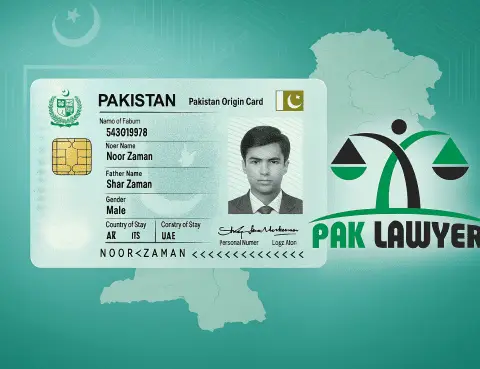
✅ How to Apply for a Pakistan Origin Card (POC) – Updated 2026 Guide
The Pakistan Origin Card (POC) is a special identity card issued by NADRA to foreign nationals with Pakistani roots, allowing visa-free entry to Pakistan and other civil privileges. As per NADRA’s latest policy, all POC applications must now be submitted through the official “Pak ID” Mobile Application. Manual or website-based applications are no longer accepted. Step-by-step guide to applying for your POC card online through the Pak-ID app.

________________________________________
📱 Step 1: Download the Official Pak ID Mobile Application:
You must start by downloading the “Pak ID” App by NADRA on your smartphone or tablet:
• 📲 For Android: Google Play Store – Pak ID App
• 📲 For iPhone/iPad: Apple App Store – Pak ID App
❗ You cannot apply via desktop browser or NADRA website anymore. The mobile app is now the only valid platform for submitting POC applications.
________________________________________
🟩 Step 2: Check Your Eligibility
You are eligible to apply for a POC if:
• You were previously a Pakistani citizen and now hold a foreign nationality.
• You are a child, grandchild, or great-grandchild of a Pakistani national.
• You are a foreign spouse of a Pakistani citizen.
• You have Pakistani ancestry and can provide supporting documents.
________________________________________
📲 Step 3: Create Your Account in the Pak ID App
1. Open the Pak ID app and select “Create New Account.”
2. Enter your:
o Full name
o Email address
o Mobile number
o Country of residence
o Passport number or other ID details
3. Set your password and confirm.
After registration, log in to the app and select “Apply for POC”.
________________________________________
📄 Step 4: Gather and Upload Required Documents
You will need to upload high-quality scanned or photographed copies of the following documents, depending on your eligibility:
For Former Pakistani Citizens:
• Copy of your Pakistani Passport (if available)
• Pakistani CNIC or NICOP (if available)
• Foreign Passport
• Recent photograph (blue/white background)
• Proof of renunciation (if applicable)
For Descendants of Pakistani Nationals:
• Parent’s or grandparent’s CNIC/NICOP or Passport
• Your foreign passport and birth certificate
• Family registration documents (if applicable)
For Foreign Spouses:
• Valid Marriage Certificate (English or Urdu)
• Spouse’s CNIC/NICOP
• Your Passport
• Passport-sized photo
________________________________________
✍️ Step 5: Biometrics & Signature Capture
The Pak ID app allows you to provide:
• Live fingerprint scans using paper and ink (as per provided format)
• Digital signature capture within the app
• Facial photo using your mobile camera
Follow the instructions in the app carefully. The app provides guides for proper fingerprint and signature submission.
________________________________________
💳 Step 6: Pay the Application Fee
Fees must be paid online through the mobile app using a credit or debit card:
Category Fee (in USD)
Adults $100 to 200
Children (<18) $50
A digital payment receipt will be generated in the app after successful payment.
________________________________________
📤 Step 7: Submit Application Once:
• All documents are uploaded,
• Biometrics and signatures are submitted,
• Fee is paid,
Then click “Submit Application.”
You will receive a Tracking ID to monitor the status of your POC.
________________________________________
📬 Step 8: Track and Receive POC
• Track your application status through the Pak ID app.
• Once approved, the card is dispatched to your given postal address (local or abroad).
• You may also opt to collect it from a NADRA Registration Centre in Pakistan (if visiting).
________________________________________
📝 Additional Information
• Validity: POC is valid for 7 years and is renewable.
• Benefits:
o Visa-free entry into Pakistan
o Right to purchase, sell, and own property
o Open bank accounts in Pakistan
o Access to basic civil services without a visa
• No need to renounce foreign nationality.
________________________________________
Read More: POC Information & Common Issues
📌 Need Assistance?
If you face any difficulties during the process, Pak-Lawyer Associates offers support for:
• Document preparation
• Biometric form assistance
• Legal affidavits for family linkage
• Spouse and child POC applications
📧 Email: ask@paklawyer.com
📞 WhatsApp: +92 321 4610092
________________________________________

Why You Should Invest in Pakistan under the SIFC Initiative
Pakistan’s economic potential is being unlocked through the Special Investment Facilitation Council (SIFC), a revolutionary initiative aimed at promoting and facilitating foreign and domestic investment in key sectors. With its investor-friendly policies, streamlined visa systems, and strategic incentives, the SIFC presents a golden opportunity for global investors. Below is a detailed overview of why investing in Pakistan under the SIFC initiative is a wise decision.

1. Priority Sectors for Investment
The SIFC focuses on several high-potential sectors that are now open for foreign investment:
- Agriculture: Pakistan’s vast and fertile land offers opportunities for modern agribusiness, high-yield crops, organic farming, and agricultural technology innovations.
- Energy: The government is emphasizing renewable energy projects, including solar, wind, and hydropower, to meet growing demand and reduce reliance on imported fuel.
- Information Technology (IT): With a tech-savvy population, Pakistan’s IT sector is rapidly growing. Investors can explore software development, outsourcing, fintech, and startups.
- Mining and Minerals: Pakistan is rich in untapped mineral resources, including copper, gold, and rare earth elements, offering significant returns in mining ventures.
- Defense Production: Investors can collaborate with Pakistan’s well-established defense industry in manufacturing and technology development.
2. Streamlined Visa and Citizenship Programs for Investors
One of the most attractive aspects of the SIFC initiative is the simplified visa system for foreign investors and Commonwealth citizens, making it easier to live, invest, and expand businesses in Pakistan.
According to the SIFC Visa Portal (SIFC Visa Information), the following key benefits are available:
- Fast-Track Investor Visas:
Foreign investors can now obtain fast-track visas through an online application process, ensuring quick and hassle-free entry. - Multiple-Entry Visas:
Multiple-entry visas with extended validity are available, allowing investors to travel frequently for business purposes without the need for frequent renewals. - Commonwealth Citizens’ Privileges:
Commonwealth citizens enjoy additional facilities, including relaxed visa requirements and the possibility of Permanent Residency (PR) in Pakistan for significant investors. - Citizenship Opportunities:
High-net-worth individuals investing in key sectors may qualify for long-term residency or Pakistani citizenship, making the country an attractive destination for global business leaders.
3. One-Window Operation for Investors
The SIFC provides a one-window operation, ensuring all investment-related processes are handled through a single platform. This approach eliminates bureaucratic delays and offers:
- Quick decision-making and project approvals.
- Coordination among federal, provincial, and military leadership for investor facilitation.
- Customized solutions and support for individual investors.
4. Youthful and Dynamic Workforce
With 64% of the population under the age of 30, Pakistan has one of the most youthful workforces in the world. This young, dynamic, and tech-savvy population is ready to drive innovation and enhance productivity for businesses in various sectors.
5. Strategic Location and Market Access
Pakistan’s strategic location at the crossroads of South Asia, Central Asia, and the Middle East offers investors unparalleled access to emerging markets. Through the China-Pakistan Economic Corridor (CPEC), businesses can benefit from improved infrastructure, logistics, and connectivity.
6. Incentives and Tax Benefits
The government offers multiple incentives to investors under the SIFC framework, including:
- Tax exemptions in key sectors for a specified period.
- Customs duty relief on the import of machinery and equipment for new projects.
- Subsidized energy tariffs for industrial projects.
Conclusion
The SIFC initiative is a game-changer for investment in Pakistan. With its streamlined visa systems, government-backed incentives, and focus on key growth sectors, Pakistan offers an attractive landscape for global investors. Whether you are interested in agriculture, energy, IT, or manufacturing, the opportunities are vast and the processes are now simpler than ever.
For more information and legal guidance on investing in Pakistan, visit Paklawyer.com or contact us at Pak-Lawyer Associates for personalized consultation.

Overseas Pakistani Divorce Procedure 2026 – Complete Legal Guide (Talaq & Khula in Pakistan)
Introduction – Overseas Pakistani Divorce Procedure 2026
The Overseas Pakistani Divorce Procedure in Pakistan has become increasingly streamlined in 2026, allowing Pakistanis living abroad to obtain a legally valid divorce without traveling to Pakistan. Whether you are residing in the UK, USA, Canada, UAE, Saudi Arabia, or Europe, Pakistani family law provides a complete legal framework for both Talaq (by husband) and Khula (by wife).
At Pak-Lawyer Associates, we specialize in handling the Overseas Pakistani Divorce Procedure efficiently through Power of Attorney, ensuring compliance with Pakistani law and international recognition of your divorce.
This comprehensive guide explains everything you need to know about the Overseas Pakistani Divorce Procedure, including legal requirements, documentation, timelines, and expert legal assistance.
Legal Framework Governing Divorce in Pakistan
The Overseas Pakistani Divorce Procedure is governed by:
- Muslim Family Laws Ordinance, 1961
- Family Courts Act, 1964
- Relevant case laws of Pakistani courts
These laws ensure that divorce is conducted through a regulated legal process, even if one or both parties reside abroad.
Who Can Use Overseas Pakistani Divorce Procedure?
This procedure applies to:
✔ Pakistani citizens living abroad
✔ Dual nationality holders
✔ Foreign spouses married under Pakistani law
✔ Couples registered through Nikah in Pakistan
Whether you are a husband seeking Talaq or a wife seeking Khula, the Overseas Pakistani Divorce Procedure allows you to complete the entire process remotely.
Types of Divorce in Pakistan:
1. Talaq (Divorce by Husband)
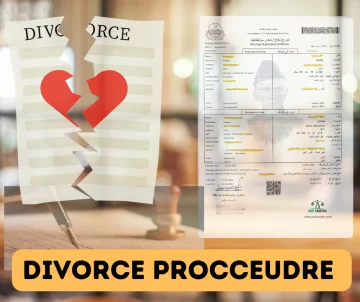
The Divorce Procedure for Talaq is administrative and relatively straightforward.
2. Khula (Divorce by Wife)
Khula requires filing a case in the Family Court, making the Divorce Procedure slightly more detailed for women.
Step-by-Step Overseas Pakistani Divorce Procedure (For Husband)
Step 1: Pronouncement of Talaq
The husband pronounces Talaq according to Islamic law and prepares a written Talaqnama.
Step 2: Submission to Union Council
The Talaq notice is submitted to the relevant Union Council where the marriage was registered.
Step 3: 90-Day Reconciliation Period
The Concerned Union Council initiates a mandatory 90-day reconciliation period.
Step 4: Confirmation of Divorce
If reconciliation fails, the divorce becomes effective after 90 days.
Step 5: Issuance of NADRA Divorce Certificate
The Union Council issues a NADRA Divorce Certificate, completing the Divorce Procedure.
Step-by-Step Overseas Pakistani Divorce Procedure (For Wife)
Step 1: Filing Khula Case
A Khula petition is filed in the Family Court through a lawyer.
Step 2: Court Proceedings
The court examines the case and attempts reconciliation.
Step 3: Decree of Khula
If reconciliation fails, the court grants Khula.
Step 4: Union Council Process
The decree is sent to the Union Council for 90-day processing.
Step 5: NADRA Divorce Certificate
After completion, the Divorce Procedure concludes with issuance of NADRA certificate.
Overseas Pakistani Divorce Without Coming to Pakistan
One of the biggest advantages of the Overseas Pakistani Divorce Procedure is that physical presence is not required.
You can appoint a lawyer through:
✔ Special Power of Attorney (SPA)
✔ Attestation from Pakistan Embassy / Consulate
✔ Courier documents to Pakistan
At Pak-Lawyer Associates, we handle the entire Overseas Pakistani Divorce Procedure remotely, saving time and cost.
Documents Required for Overseas Pakistani Divorce Procedure
To complete the Divorce Procedure, you will need:
- CNIC / NICOP / Passport copies
- Nikah Nama (Marriage Certificate)
- Address proof (abroad)
- Power of Attorney
- Divorce deed (if applicable)
Our legal team ensures proper documentation to avoid delays.
NADRA Divorce Certificate – International Validity
The final step in the Overseas Pakistani Divorce Procedure is obtaining the NADRA Divorce Certificate, which is:
✔ Legally valid in Pakistan
✔ Acceptable in UK, USA, Canada, UAE
✔ Required for remarriage
✔ Useful for immigration and visa processing
We also assist in:
✔ MOFA attestation
✔ Embassy legalization
✔ International documentation compliance
Common Problems in Divorce Procedure
Many clients face issues due to lack of proper legal guidance:
❌ Incorrect Talaq notice submission
❌ Missing Union Council jurisdiction
❌ Delay in 90-day reconciliation period
❌ Improper Power of Attorney attestation
❌ Non-recognition abroad
At Pak-Lawyer Associates, we eliminate these risks by managing the entire Divorce Procedure professionally.
Why Choose Pak-Lawyer Associates?
When it comes to the Overseas Pakistani Divorce Procedure, choosing the right legal team is critical.
✔ 18+ Years of Legal Experience
We have extensive expertise in handling complex overseas divorce cases.
✔ No Need to Visit Pakistan
Complete Overseas Pakistani Divorce Procedure handled remotely.
✔ 500+ Cases Successfully Resolved
Strong track record in family law matters.
✔ UK & International Client Support
We regularly assist clients from UK, USA, Canada, UAE, and Europe.
✔ Fast & Reliable Processing
We ensure timely completion of the Overseas Pakistani Divorce Procedure.
✔ Confidential & Professional Service
Your privacy is always protected.
Timeline of Overseas Pakistani Divorce Procedure
| Stage | Duration |
|---|---|
| Talaq Notice Submission | Immediate |
| Reconciliation Period | 90 Days |
| Certificate Issuance | Few days after completion |
👉 Total time: Approx. 90–120 days
Important Legal Advice
- Divorce is not complete until Union Council confirms it
- Court decree alone is not sufficient
- NADRA certificate is essential for legal proof
- Always follow proper Overseas Pakistani Divorce Procedure
👉 Read more: Divorce Procedure in Pakistan (Complete Guide 2026)
Conclusion:
The Overseas Pakistani Divorce Procedure in 2026 is designed to facilitate Pakistanis living abroad by providing a legal, efficient, and remote solution.
With proper legal representation, you can:
✔ Complete divorce without travel
✔ Obtain NADRA certificate
✔ Ensure international legal validity
Contact Pak-Lawyer Associates
If you are looking for expert assistance in the Overseas Pakistani Divorce Procedure, contact us today:
📞 +92 321 4610092
📧 ask@paklawyer.com
🌐 www.paklawyer.com

Adoption from Pakistan to Sweden: A Legal Guide:
Adopting a child from Pakistan to Sweden is a complex legal process that requires compliance with both Pakistani and Swedish laws. Since Pakistan does not formally recognize adoption under Islamic law but allows legal guardianship, Swedish citizens seeking to adopt a child from Pakistan must navigate both legal systems carefully. This article provides a step-by-step guide to the adoption process and its legal requirements under Swedish law, particularly HSLF-FS 2022:25.

Understanding the Legal Framework
1. Eligibility for Adoption in Sweden
Before initiating an adoption, Swedish law requires the adoptive parent to meet certain conditions:
- Age Requirement: The adoptive parent must be at least 25 years old. Exceptions exist for relative adoptions.
- Suitability Assessment (Medgivandeutredning): Conducted by the Swedish Social Welfare Board (Socialnämnden) to evaluate the applicant’s ability to provide for the child’s well-being.
- Compulsory Parental Education: Before applying for adoption approval, prospective adoptive parents must complete an adoption preparation course.
- Known Child Adoption Considerations: If adopting a relative’s child, Swedish authorities assess whether the adoption serves the child’s best interests.
2. The Adoption Process in Sweden
Step 1: Obtaining Adoption Approval in Sweden
The first step is obtaining permission to adopt from Socialnämnden. This involves:
- Home Study & Investigation: Authorities review the applicant’s mental and physical health, financial stability, and social support system.
- Child’s Best Interests Review: The adoption must provide clear benefits for the child compared to alternative care arrangements in Pakistan.
- Approval Decision: If approved, the applicant receives a certificate of suitability for adoption.
Step 2: Legal Process in Pakistan
Since Pakistan does not allow full legal adoption under Islamic law, the process follows guardianship laws:
- The adoptive parent must apply for legal guardianship under the Guardians and Wards Act, 1890 through the Family Court in Pakistan.
- The Pakistani court grants guardianship after reviewing the adoptive parent’s financial and social conditions.
Step 3: Recognition of the Adoption in Sweden
- Once guardianship is granted in Pakistan, the adoptive parent must apply to the Swedish Family Law and Parental Support Authority (MFoF) for recognition.
- As Pakistan is not a signatory to the Hague Adoption Convention, additional legal scrutiny is required.
- Upon approval, the adoption is recognized under Swedish law.
3. Immigration Process for the Adopted Child
After the adoption is recognized, the child must apply for legal residency in Sweden:
- Citizenship for Children Under 12: If the adoption is legally recognized, the child may automatically acquire Swedish citizenship.
- Residence Permit for Older Children: If the child is over 12, an application for a residence permit must be submitted to the Swedish Migration Agency (Migrationsverket).
- Family Reunification Visa: If required, the child may need a temporary visa to enter Sweden before permanent residency is approved.
4. Post-Adoption Requirements in Sweden
Upon arrival in Sweden, Swedish authorities may conduct follow-up assessments to ensure the child’s well-being. The adoptive parents may also be required to:
- Notify child healthcare services (barnhälsovård) for medical check-ups.
- Register the child with local authorities and schools.
- Participate in post-adoption support programs if needed.
5. Key Challenges and Legal Considerations for Adoption from Pakistan to Sweden
| Challenges | Legal Solutions |
|---|---|
| Pakistan does not allow full adoption | Obtain legal guardianship and seek Swedish recognition. |
| Approval required before proceeding with adoption | Complete medgivandeutredning before applying in Pakistan. |
| Pakistan is not part of the Hague Adoption Convention | Swedish authorities will review the case individually. |
| Immigration issues for the child | Apply for a residence permit or citizenship with Migrationsverket. |
Final Recommendations:
- Initiate adoption proceedings in Sweden first – Secure approval from Socialnämnden before proceeding to Pakistan.
- Follow Pakistani guardianship laws – Obtain guardianship through Pakistani courts.
- Apply for adoption recognition in Sweden – Submit the necessary documents to MFoF.
- Complete the child’s immigration process – Work with Migrationsverket for residence and citizenship applications.
Need Legal Assistance?
Due to the complexities of international adoption, it is advisable to seek legal guidance. If you are considering adopting a child from Pakistan, consult an experienced family law attorney in Sweden or Pakistan to ensure compliance with all legal requirements.

For professional legal assistance, visit www.paklawyer.com or contact us for expert advice on adoption and immigration matters. You may also visit our website for a detailed adoption procedure.
Understanding the Amendments to the Prevention of Electronic Crimes Act (PECA) – New Social Media Law
By Gull Hassan Khan Advocate

The landscape of social media regulation in Pakistan has just experienced a significant shift with the recent amendments to the Prevention of Electronic Crimes Act (PECA). These amendments introduce new provisions that empower the government to curb the spread of disinformation on digital platforms, impose substantial fines, and hold social media platforms more accountable for content shared by their users. Below, we explore the key features of the updated law, its penalties, and what this means for individuals and companies operating in the digital space.
1. Criminal Penalties for Spreading Disinformation
One of the most impactful provisions in the amended PECA is the introduction of criminal penalties for the dissemination of false or misleading content on social media. The new regulation, under Section 4, enables authorities to imprison individuals for up to three years for engaging in disinformation campaigns. Disinformation is defined broadly under the law, encompassing any false, misleading, or deceptive content that is deliberately spread with the intention to mislead the public or cause harm.
This change has significant implications for social media users, as it opens the door to criminal prosecution for anyone found guilty of intentionally spreading false information. As disinformation has become a growing concern globally, Pakistan’s move to introduce stringent penalties aims to safeguard the integrity of information in the digital age.
2. Substantial Financial Penalties
In addition to the possibility of imprisonment, the amended PECA law also empowers the government to impose hefty fines. Under Section 5, those found guilty of spreading disinformation can face monetary fines up to 2 million rupees (roughly $7,168). This fine is designed to serve as both a deterrent and a mechanism for holding individuals and entities accountable for their actions on social media platforms.
These penalties are part of a broader strategy to ensure that those who misuse social media for harmful purposes face serious consequences. As a result, both individuals and businesses must take extra care to verify the content they share online to avoid the risk of penalties.

3. Social Media Platforms Required to Register
The law now requires social media platforms to register with the newly established Social Media Protection and Regulatory Authority (SMPRA). This move is designed to provide the government with more control and oversight over platforms operating in Pakistan. Section 7 of the new amendment stipulates that all social media platforms, whether domestic or international, must comply with this registration requirement.
Failure to register could result in severe penalties, including the potential ban of platforms that do not comply. This provision seeks to ensure that all social media platforms adhere to local regulations and cooperate with the government in managing digital content more effectively.
4. Obligations for Content Removal
The government now holds social media platforms responsible for removing content deemed harmful, unlawful, or detrimental to national security. As per Section 9, platforms will be required to comply with government orders to remove such content within a specified timeframe.
Failure to do so could result in financial penalties or even the suspension of services within the country. This clause places a heavy burden on social media companies to take a more active role in monitoring and filtering content that might violate local laws or societal norms.
5. Platform Accountability for User Content
The amendments introduce Section 13, which emphasizes the responsibility of social media platforms for user-generated content. Under this section, platforms are now obligated to monitor, report, and remove any content that violates Pakistani law. This regulation seeks to ensure that platforms are not simply passive hosts for content but take active steps to prevent the spread of harmful information and illegal material.
In addition, platforms are required to work closely with the government and provide support during investigations into disinformation or other illegal activities carried out on their networks.
6. Enhanced Enforcement and Compliance
The Social Media Protection and Regulatory Authority (SMPRA) will be tasked with enforcing the new provisions. According to Section 12, the SMPRA will have the authority to issue compliance notices, conduct investigations, and initiate actions against violators. This centralized body will oversee all aspects of the new regulations and ensure that both individuals and platforms comply with the law.
Conclusion: What This Means for You
The amendments to PECA represent a major shift in the way social media is regulated in Pakistan. The law significantly expands the powers of the government to address the spread of disinformation, hold individuals accountable for harmful content, and ensure that social media platforms play a more active role in curbing illegal activity online.
For individuals and businesses using social media, these changes mean greater scrutiny of the content shared on digital platforms. It is more important than ever to verify information before posting and to ensure compliance with local regulations to avoid potential fines or imprisonment.
Pak-Lawyer Associates advises clients in the digital space to stay informed about these changes and adopt best practices for content sharing and platform management. If you need legal advice or assistance navigating the complexities of the amended PECA law, do not hesitate to contact us.
Stay informed. Stay compliant.
This blog post captures the essence of the amendments to PECA, providing a comprehensive yet accessible summary of the new law and its implications.
These guidelines outline the procedural requirements for the Attestation of Medical Documents, ensuring adherence to the protocols established by relevant health authorities.
I. Degrees, Diplomas, and Experience Certificates
- Medical Professionals (MBBS/PMDC):
- Degrees, diplomas, and experience certificates of doctors, pharmacists, and paramedics must be attested by the Ministry of National Health Services.
- Nursing Diplomas:
- Nursing diplomas and other health-related certificates must also bear attestation from the Ministry of National Health Services.
II. Medical Fitness Certificates
- Medical fitness certificates must be signed by one of the following authorized officials:
- Medical Superintendent (MS),
- Deputy Medical Superintendent (DMS),
- Civil Surgeon,
- Director of the Medical Board, or
- District Health Officer (DHO).
III. Medical Certificates for Bed Rest
- Certificates for bed rest on medical grounds must:
- Be signed by the MS, DMS, Civil Surgeon, Director of the Medical Board, or DHO.
- Exclude any mention of prescribed medicines.
IV. Covid-19 Related Documents
- Lab Test Reports:
- Covid-19 lab test reports are attested if issued by a government hospital or institute, with the doctor’s or authorized officer’s name, seal, and signature.
- Vaccination/Immunization Certificates:
- Covid-19 vaccination and immunization certificates issued by NADRA are eligible for attestation.
V. Polio Immunization Certificates
- Polio immunization certificates issued by the District Health Department are also attested.
Read More: Attestation of Death and Birth Certificate


Attestation of Nikkah Nama/Marriage Registration Certificate (MRC)
- Normal Nikkah Nama:
- The original Nikkah Nama, issued by the Nikkah Registrar, must bear his signature and stamp.
- A Marriage Registration Certificate (MRC) is mandatory along with the Computerized National Identity Card (CNIC) of the bride showing the husband’s name, or alternatively, a Family Registration Certificate (FRC) or Children Registration Certificate (CRC) issued by NADRA (if there are children born after the marriage).
- Online Marriage Nikkah Nama:
- For marriages conducted online, the original Nikkah Nama must be duly signed by the bride, groom, and witnesses, with their thumb impressions affixed. The same documentary requirements as for a normal Nikkah Nama apply.
- Nikkah Nama of Azad Jammu and Kashmir (AJK):
- A Nikkah Nama issued in AJK must be signed and stamped by the Tehsil Mufti. Additionally, the CNIC of the bride bearing the husband’s name or an FRC from NADRA is required.
- Nikkah with Foreign National:
- The Nikkah Nama and Marriage Registration Certificate (MRC) must be accompanied by:
- A copy of the foreign spouse’s passport,
- A valid Pakistani visa, and
- Proof of the date of entry into Pakistan.
- No Nikkah Nama or Marriage Certificate will be attested without these documents.
- The Nikkah Nama and Marriage Registration Certificate (MRC) must be accompanied by:
- Overseas Marriage Nikkah Nama:
- For marriages conducted abroad, the Nikkah Nama/Marriage Registration Certificate (MRC) must first be attested by the local Foreign Office of the issuing country and countersigned by the concerned Pakistani Diplomatic Mission.
- Divorce Certificates and Related Documents
- Normal Divorce Certificate:
- Divorce certificates must be issued by either:
- The Chairman of the Arbitration Council, or
- The Secretary of the Union Council.
- Photocopies must be attested by the issuing authority.
- Only the spouses themselves may apply for attestation. Blood relatives or friends are not permitted unless the applicant resides abroad and has executed a Power of Attorney in favor of a blood relative/friend, which must be duly attested by the Pakistani Embassy/Consulate in that country.
- Divorce certificates must be issued by either:
- Divorce Deed:
- A Computerized Divorce Certificate is mandatory for the attestation of a divorce deed.
- Divorce Proceedings and Notices:
- Divorce proceedings and notices must be attested by the relevant Arbitration Council.
- Court-related divorce proceedings must be routed through a competent Court of Law.
III. Unmarried Certificate
- Issuance Requirements:
- The unmarried or single marital status certificate must be issued by the Secretary of the concerned Union Council.
- It must be printed on the official letterhead of the Union Council and bear the Secretary’s signature and stamp.
- Certificates issued on plain paper or in the name of the Chairman or a member of the Union Council will not be attested by the Ministry.
Read More : Educational Document Attestation by MOFA

Attestation of Educational Documents by MOFA
These guidelines provide the requisite procedural requirements for attestation of various educational and related documents. Adherence to these standards is mandatory to ensure successful attestation.
I. Educational Documents:
1. Matriculation and Intermediate Certificates
o Certificates issued by the Boards of Intermediate and Secondary Education (BISE) must first be countersigned by the Inter Board Committee of Chairmen (IBCC).
2. University Degrees
o Degrees conferred by universities are required to be attested by the Higher Education Commission (HEC).
o Medical degrees must be attested by both the Higher Education Commission (HEC) and the Ministry of National Health Services.
3. Technical Skill Certificates
o Certificates pertaining to technical skills must be attested by the relevant local technical board and the National Vocational & Technical Training Commission (NAVTTC).
4. Equivalence Certificates
o For educational documents issued from foreign institutions, equivalence certificates must be obtained and attested by the appropriate departments, i.e., the Inter Board Committee of Chairmen (IBCC) and the Higher Education Commission (HEC).
II. Professional and Specialized Certifications
1. ACCA/ICAP Certifications
o Certificates issued by the Association of Certified Chartered Accountants (ACCA) must be attested by the British Council and ACCA.
o Result cards and certificates from the Institute of Chartered Accountants of Pakistan (ICAP) are required to be attested by the authorized officer of ICAP.
2. ICMAP Certifications
o Result cards and certificates issued by the Institute of Cost and Management Accountants of Pakistan (ICMAP) must be attested by the authorized officer of ICMAP.
3. Certificates from Madaris
o Certificates issued by Madaris must be attested by the Inter Board Committee of Chairmen (IBCC) or the Higher Education Commission (HEC), as applicable, before submission to the Ministry of Foreign Affairs (MOFA).
4. Hifz-ul-Quran Certificates
o Certificates of Hifz-ul-Quran are required to be attested by the Inter Board Committee of Chairmen (IBCC) prior to attestation by MOFA.
Bonafide Certificate Issued by Universities
1. A Bonafide Certificate issued by a university must be attested by the Registrar or Deputy Registrar of the issuing university.
2. For regular students, the applicant is required to submit a photocopy of the student identification card.
3. For former students, the applicant must provide a copy of the certificate or degree duly attested by the Higher Education Commission (HEC).
II. Bonafide Certificate Issued by Schools/Colleges
1. A Bonafide Certificate issued by schools or colleges must be attested by the District/Area Education Officer or the Director of Schools & Colleges.
2. For current students, the applicant is required to submit a photocopy of the student identification card.
3. For former students, the applicant must provide a copy of the certificate or degree duly attested by the Inter Board Committee of Chairmen (IBCC).
III. Character Certificates from Educational Institutions
1. Character Certificates issued by educational institutions shall be attested if:
o Issued, signed, and stamped by the Registrar or Deputy Registrar of a university; or
o Issued, signed, and stamped by the Principal of a college or school.
2. For current students, the applicant is required to submit a photocopy of the student identification card.
3. For former students, the applicant must provide a copy of the certificate or degree duly attested by the IBCC or HEC, as applicable.
. School Leaving Certificates
1. Government and Private Schools:
o School Leaving Certificates issued by government or private schools must be attested by the Inter Board Committee of Chairmen (IBCC) or the District Education Officer/Private Educational Institutions Regulatory Authority (PEIRA).
2. Educational Institutions of Defense Forces:
o School Leaving Certificates issued by educational institutions of the Army, Air Force, or Navy must be attested by the Commanding Officer of the respective Educational Directorate or an authorized officer.
II. Educational and Experience Certificates from Abroad
• Educational degrees and experience certificates issued by foreign authorities must be attested by the respective Pakistani Mission located in the country of issuance.
III. IELTS/TOEFL and Similar Certificates
1. Certificates such as IELTS, TOEFL, and similar qualifications are eligible for attestation under the following conditions:
o For documents issued abroad, they must be signed/verified by the local Foreign Office and the Pakistani Mission in the country of origin.
o For documents issued in Pakistan, they must be signed/verified by the British Council or the relevant Embassy in Pakistan.
2. All other international certificates must similarly be attested if verified by the local Foreign Office and the Pakistani Mission in the country of origin.
IV. Reference Letters from Professors
• Reference letters from professors, intended for academic purposes, whether issued by foreign or national educational institutions, must meet the following criteria for attestation:
o Signed and stamped by the concerned professor; and
o Countersigned by the Registrar of the issuing university.
